
Introduction
Today’s article is not a watch review. It is a nostalgic look back at a somewhat unusual and relatively short chapter in the development of alarm wristwatches.
What prompted me to write this piece was the fact that, after a long search, I accidentally found not just one but two Nepro alarm watches this January — finally completing my collection of watches from this company. That also gave me the opportunity to present the collection in more detail.
Let me say right at the beginning: Nepro alarm watches are something of an intruder in my collection of mechanical alarm watches, because they are not fully mechanical. However, since the core of the watch is still a mechanical movement, I decided they deserve a place in the collection.
But let’s start at the beginning.
In the early 1970s, the Swiss watch industry is often described as conservative, complacent, and unprepared for what was coming — the well-known quartz crisis.
That narrative is only partially true. Before quartz swept through the market, some manufacturers were already experimenting with electronic components inside mechanical systems. Since my focus is alarm watches, I am particularly interested in those who explored hybrid solutions — mechanical timekeeping combined with electronic sound generation. Among the most technically interesting, and today largely forgotten, was Nepro Watch of La Chaux-de-Fonds.
The Nepro Alarm Clock Period
Their story did not begin with wristwatches. The company was founded in 1958, and even the name — created as an abbreviation of “NEw PROducts” — clearly indicates their ambition to stand out through innovation.
They began with alarm clocks. Their goal was to develop the smallest possible travel alarm clocks. They focused on hybrid technologies, combining mechanical timekeeping with electronic buzzers powered by button batteries. While many traditional alarm watches relied on mechanical hammers striking usually to the caseback, Nepro pursued a different approach: transistorized oscillators driving compact acoustic generators.
By the late 1960s, the company had reportedly produced hundreds of thousands of compact acoustic units, including switching clocks for radios. This experience in miniaturized sound generation became the technical foundation for their later alarm wristwatches.
By the end of the 1960s, mechanical alarm watches were limited by case resonance and physical damping. Electronic buzzers, in contrast, allowed controlled frequency, reduced component size, and theoretically more consistent sound output. The real challenge was not generating sound — it was miniaturization and integration into a waterproof, shock-resistant wristwatch case.
Before solving that, Nepro tested the concept in a transitional format.
The Bridge Model: Nepro Zanzara
The Zanzara represents the evolutionary link between Nepro’s miniature alarm clocks and its wristwatch ambitions.
The name — “Zanzara,” Italian for mosquito — refers to the distinctive buzzing tone of the electronic acoustic unit.
The Zanzara was not yet a fully integrated wrist alarm solution in the later modular sense. Instead, it translated Nepro’s electronic buzzer expertise into a portable wearable format, maintaining a clearer separation between traditional timekeeping mechanics and the electronic sound module.
To be a bit blunt, they essentially modified the case of an existing miniature alarm clock and added lugs. The alarm clock that served as the “mother” of the Nepro Zanzara wrist alarm can be seen in the photos below. The entire case measures 42 × 30 mm.


The smaller version of Zanazara
Very importantly, Nepro eliminated traditional wiring. The “Rotocontact” system mounted on the dial used a contact spring and contact wheel driven by the setting mechanism, allowing electrical transmission without loose wires and without modifying the base calibre. I will show that in more detail later.
Zanzara was launched in 1970 and produced in two versions.
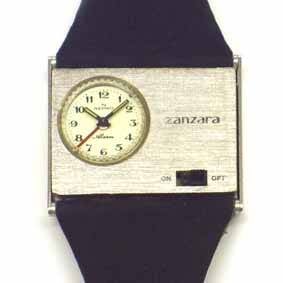
The first, smaller version measured 36 × 30 mm and even retained the base of the original alarm clock. The lugs were mounted onto this base, and the watch itself could be lifted out. I do not own this version, but I include photos found online.

The bigger version of Zanzara
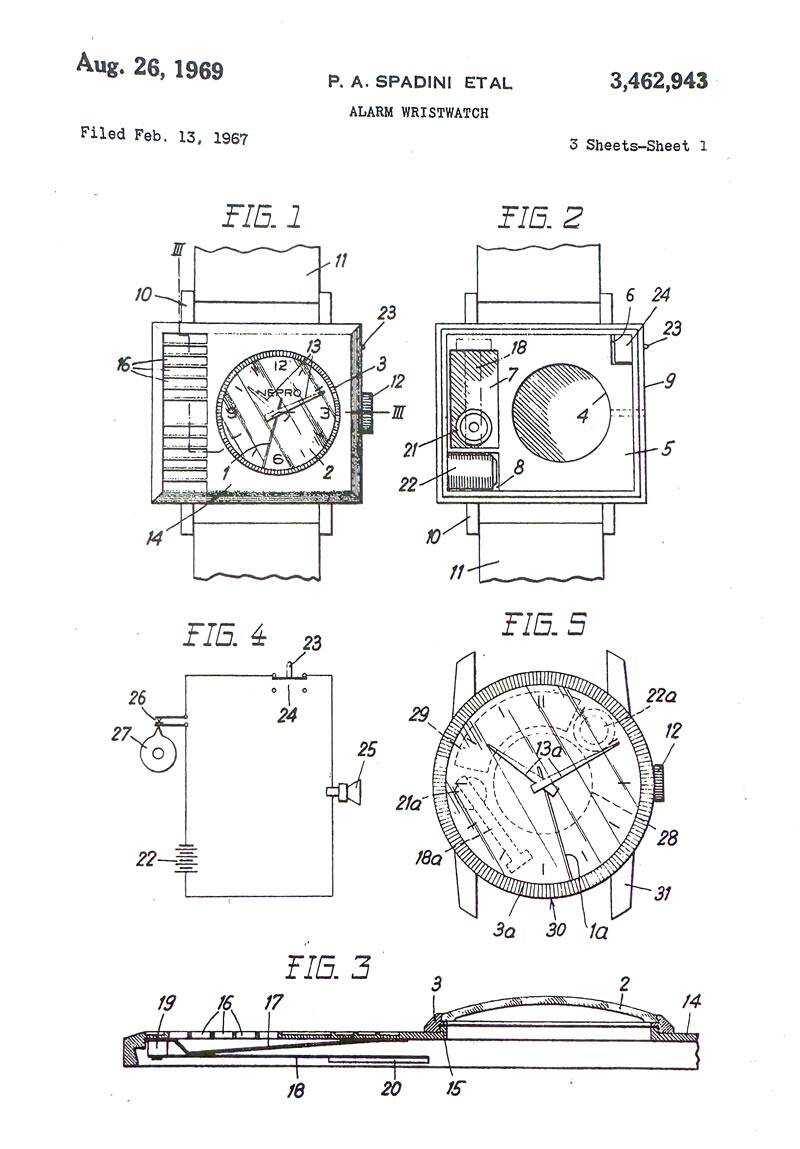
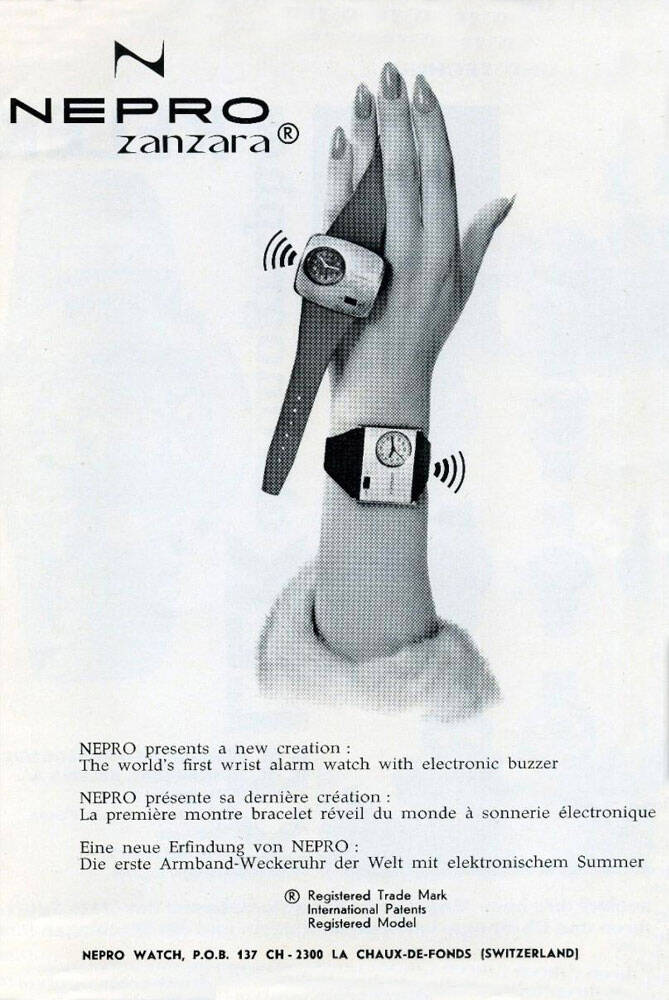
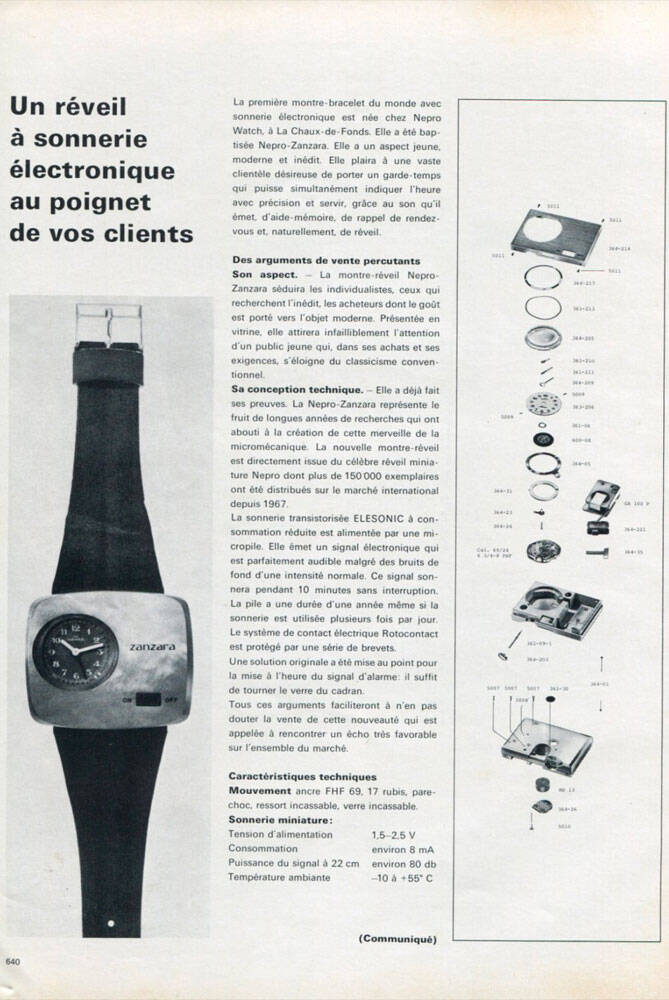

Marketing articles about Zanzara with some technical explanations
The second version — the one I own — was closer to a proper wristwatch. It featured a unified chrome-plated case with integrated lugs (with a rather unusual 30 mm lug width). Its dimensions were 42 × 37 mm. Both versions were marketed as women’s watches, although the larger one could easily pass as a men’s watch by size. Check it on my almost 19cm wrist:


One awkward aspect is access to the winding crown, which is only reachable from the back, and even there it is difficult to grip. On the other hand, alarm control from the front of the watch is very practical.
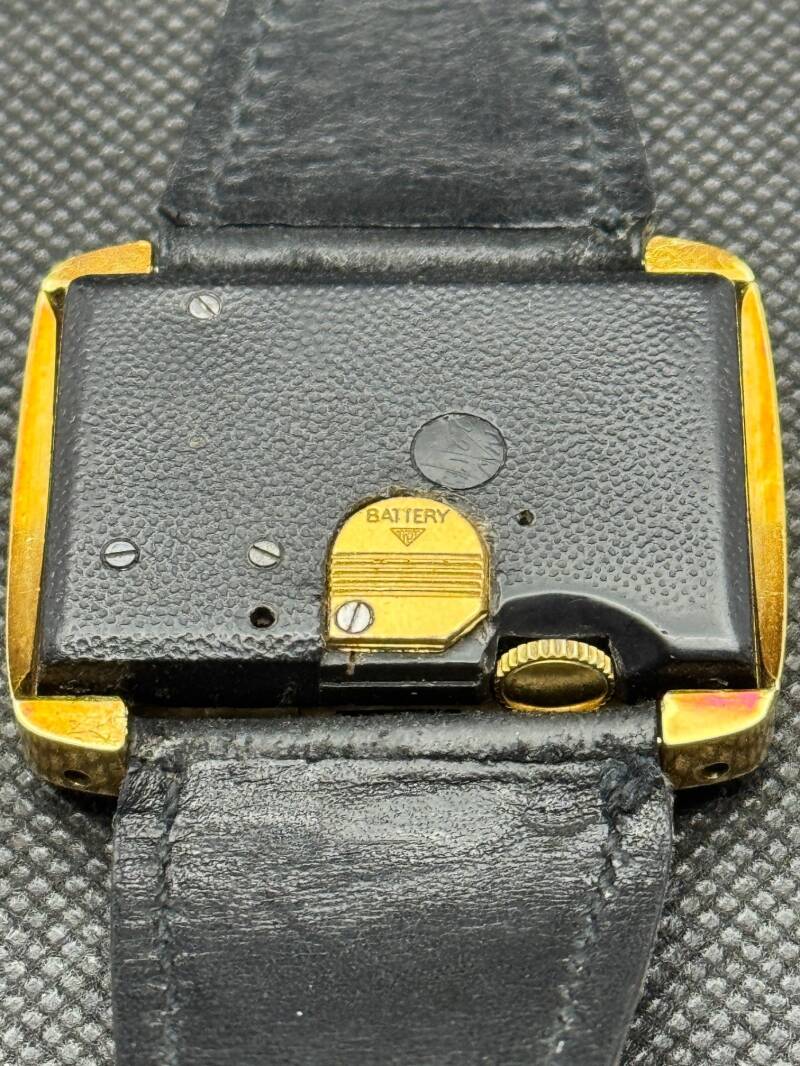
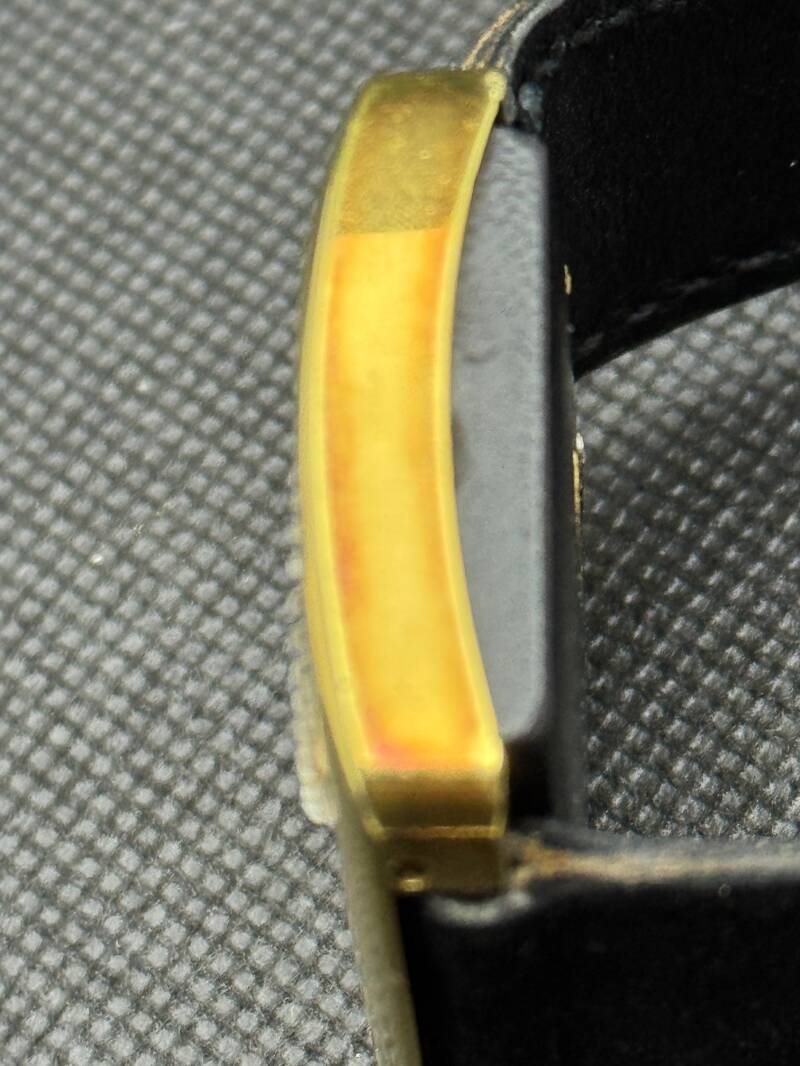
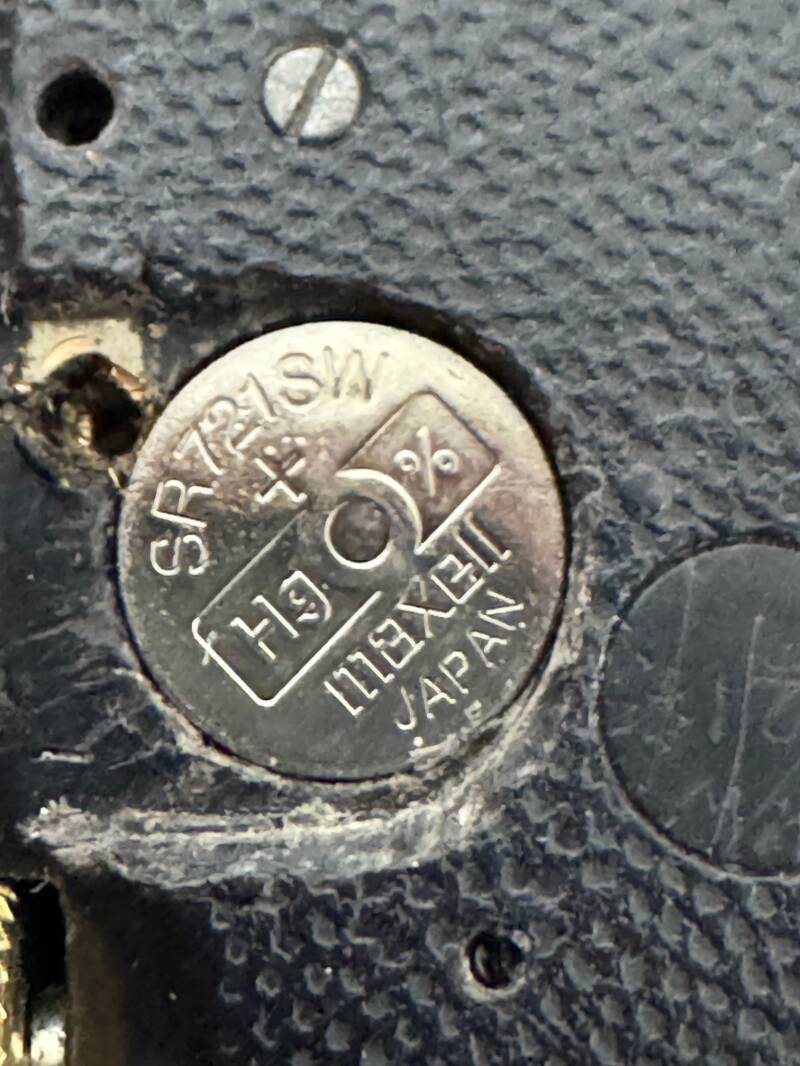
Back side of Zanzara with the battery compartment
Let us now see, how the watch looks inside. The mechanical part was powered by a manually wound FHF 69 movement (17 jewels, 18,000 A/h). The alarm hand was set by rotating the acrylic crystal. The alarm module was powered by a 1.5V battery. The caseback remained plastic. The electronic module sat next to the mechanical movement and was connected via the Rotocontact system.
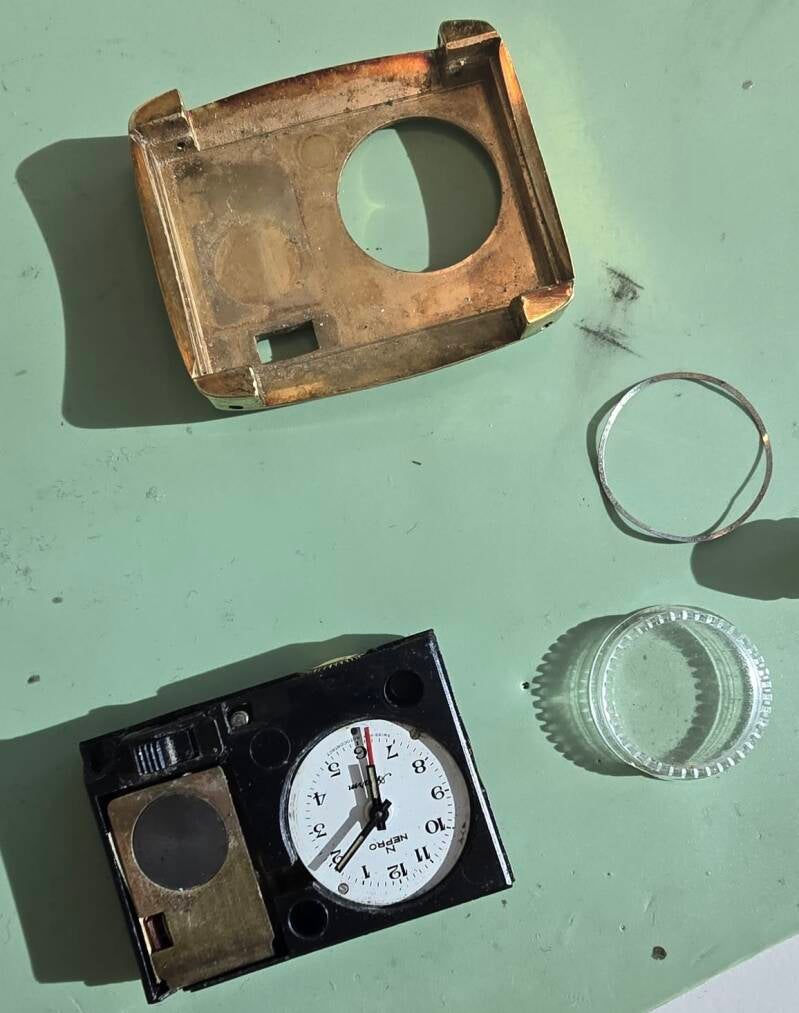
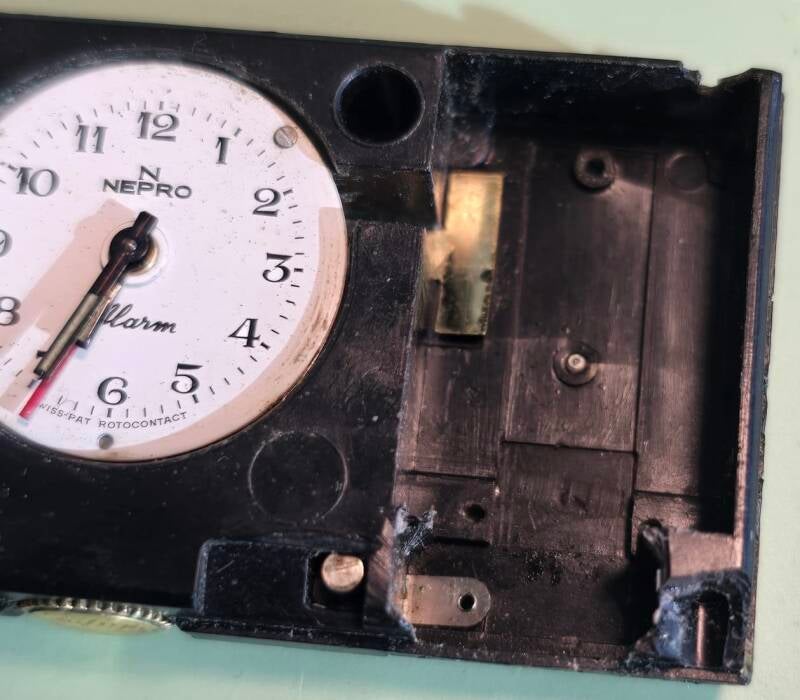
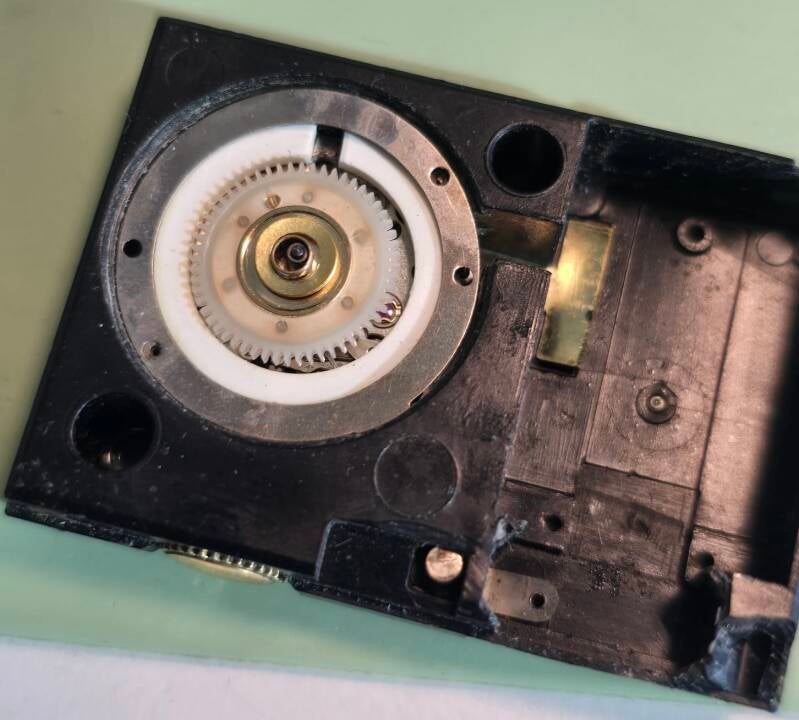

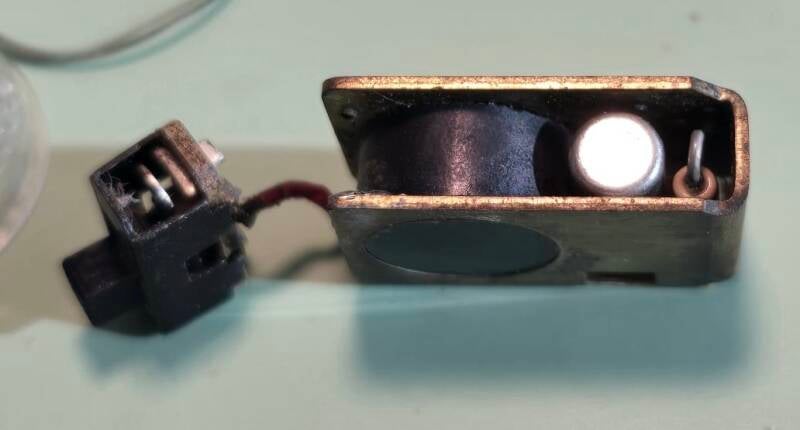
Construction of Zanzara

Ruhla Sumatic
The alarm emitted a continuous buzzing sound (see video). It could ring uninterrupted for up to five minutes.
During its promotion, Nepro proudly claimed Zanzara was the first alarm wristwatch that did not require winding of the alarm and was powered by a battery. That claim is probably not entirely accurate. Behind the Iron Curtain, East German company Ruhla developed a similar hybrid concept — the Ruhla Sumatic alarm clock. Based on that concept, Ruhla reportedly developed a wrist alarm watch even before the Zanzara. Very little is known about it. Some sources even claim it never reached the market. I managed to find only one photo of what it supposedly looked like, which I am happy to share. If anyone knows more about this watch — or even has one for sale — I would gladly hear from you.
But let’s return to the Nepro Zanzara.
Conceptually, Zanzara answered one question: can an electronic buzzer be small, robust, and efficient enough for daily personal use? By all accounts, yes.
And that was more than enough for Nepro to move toward fully developed hybrid alarm wristwatches.
Memotron – “The World’s First Alarm Watch Without Winding”
In 1972, at the Basel Fair, Nepro unveiled two watches sharing the same acoustic DNA but differing in execution — Memotron and Elevox.
The Memotron was positioned as the world’s first alarm wristwatch whose movement and alarm mechanism no longer required winding.
To understand that claim, a short technical clarification is necessary.
Alarm watches can broadly be divided into two categories. In the first category, movements have two separate spring barrels — one for timekeeping and one for the alarm. In the second category, both functions share the same spring barrel, meaning that the alarm drains the timekeeping reserve. In such movements, a limiter was essential to prevent the alarm from fully depleting the power reserve.
Before 1970, most alarm watches required manual winding of both the timekeeping and, if separate, the alarm spring barrels. Gradually, automatic winding was introduced. Jaeger-LeCoultre introduced calibre 815 in 1956 with automatic winding for timekeeping but manual winding for the alarm (Interestingly, JLC still uses this exact approach today, claiming it is intentional, as it gives the user full control over the state of the alarm’s power reserve.). Seiko followed in 1966 with the Bell-Matic — automatic for timekeeping, manual for alarm. Raketa 3031 followed in 1972 with a similar approach.
In 1969, Lemania developed calibre 2980, a fully automatic alarm movement belonging to the second category — meaning both timekeeping and alarm functions shared the same spring barrel. Shortly afterwards, Omega introduced its closely related and technically refined sister calibre, the Omega 980, used exclusively in the Omega Seamaster Memomatic. The two movements coexisted in parallel: Lemania 2980 was available to other manufacturers, while Omega 980 remained reserved for Omega’s own Memomatic model.
The first movement with two separate mainsprings, both automatically wound, was developed by A. Schild with calibres 5007/5008. The first official watch appeared in 1973, but experimental models existed earlier.
So, was the Memotron truly the first alarm wristwatch that required no winding? If interpreted as the first fully automatic alarm watch overall, then no — Lemania and Omega achieved that earlier. But if interpreted as the first one with separate barrel of time and alarm, yet requiring no manual winding for either, then conditionally yes — although experimental A. Schild 5008 models appeared earlier.
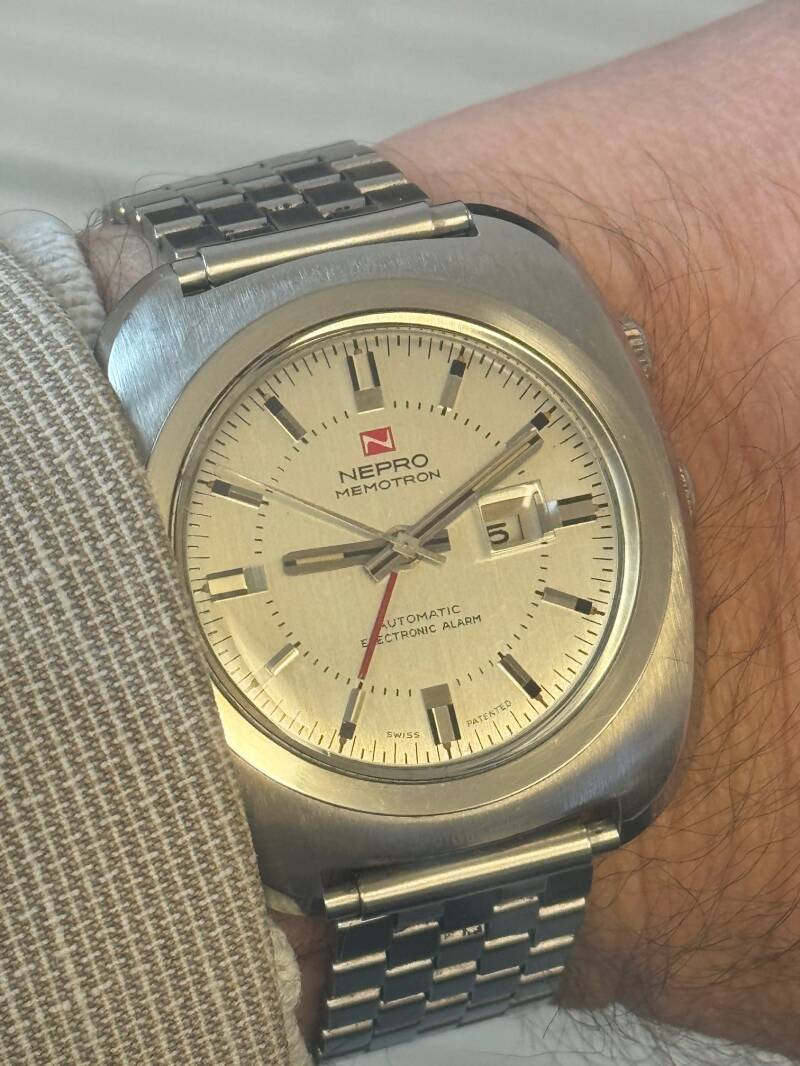

Memotron used the ETA 2671 automatic calendar calibre (28,800 vph, hacking seconds, quick date, over 45 hours reserve, Incabloc, antimagnetic).
Visually, Memotron appeared as a standard square men’s watch (37 mm side) with two crowns — one for timekeeping and one for alarm setting and activation. No more resemblance to alarm clocks.
The alarm module consisted of:
- A transistorized oscillator
- An elastic tongue fixed at both ends
- A tuned membrane
- A 1.5V battery (“Element”) measuring 7.9 × 3.6 mm (40 mAh)
Regarding the battery: based on official launch documents, it corresponds to battery 392 (SR41). However, in all Memotrons I have seen, battery 393 (SR48) is used — same diameter but thicker (5.4 mm). This battery also fits my Elevox, and the holder has a small extension allowing the thicker cell. It is possible that 392 was originally intended. Interestingly, Zanzara uses a 362 (SR721) battery — same diameter (7.9 mm) but thinner (2.1 mm).
The acoustic generator measured less than 0.8 cm³. The alarm could sound for up to five minutes unless manually stopped. You can again check the sound in the video.
Structurally, Memotron was built around three main elements:
- The (acrylic) crystal
- A metal mid-case housing the ETA 2671
- A Noryl synthetic structural back plate housing the alarm module and battery

Each component sat in a separate sealed chamber. This achieved two protections: battery leakage could not damage the movement, and water ingress through the alarm membrane could not spread through the watch.
This was a true modular architecture.
Visually, Memotron appeared as a standard square men’s watch (37 mm side) with two crowns — one for timekeeping and one for alarm setting and activation. No more resemblance to alarm clocks.
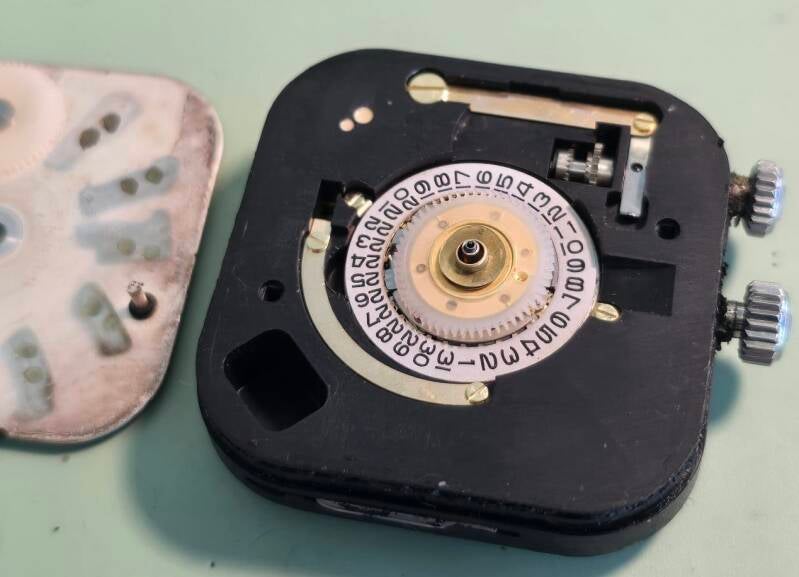
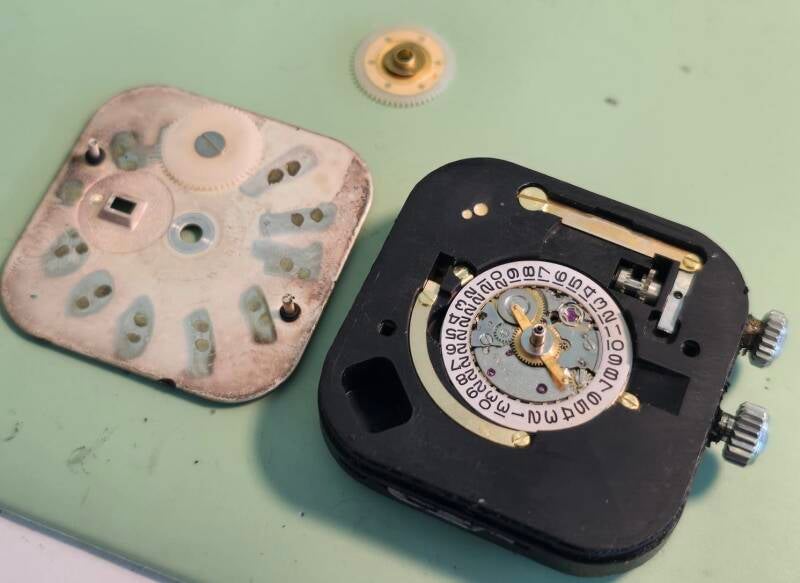

Rotocontact system
In the photos above, the functioning of the “Rotocontact” system is clearly visible. Checking the photos of Zanzara you can notice, that both watches uses the same system. It's time to explain how the Rotocontact works.
The core of the mechanism consists of two metal contact springs positioned beneath a plastic gear. The metal contact springs are mechanically linked to and rotate with the hour wheel, while the plastic gear is driven by and rotates with the alarm-setting mechanism.
The plastic gear features two drilled holes positioned opposite each other. When the rotating contact springs reach the precise position where their tips fall into these holes, the spring tips simultaneously make contact with the metal dial surface, thereby closing the electrical circuit and activating the alarm.
The contact springs remain seated in the holes for approximately five minutes, until the continued rotation of the hour wheel lifts them out again. This is why the watch can sound continuously for up to five minutes. (Since the alarm is powered by a battery, the duration of the ringing is not limited by a mechanical power reserve.)
A careful observer will notice that the two holes are not positioned at equal distances from the axis of rotation, and the two contact springs are not of identical length. This geometry ensures that both springs engage simultaneously in the holes at only one precise position within each 12-hour cycle.
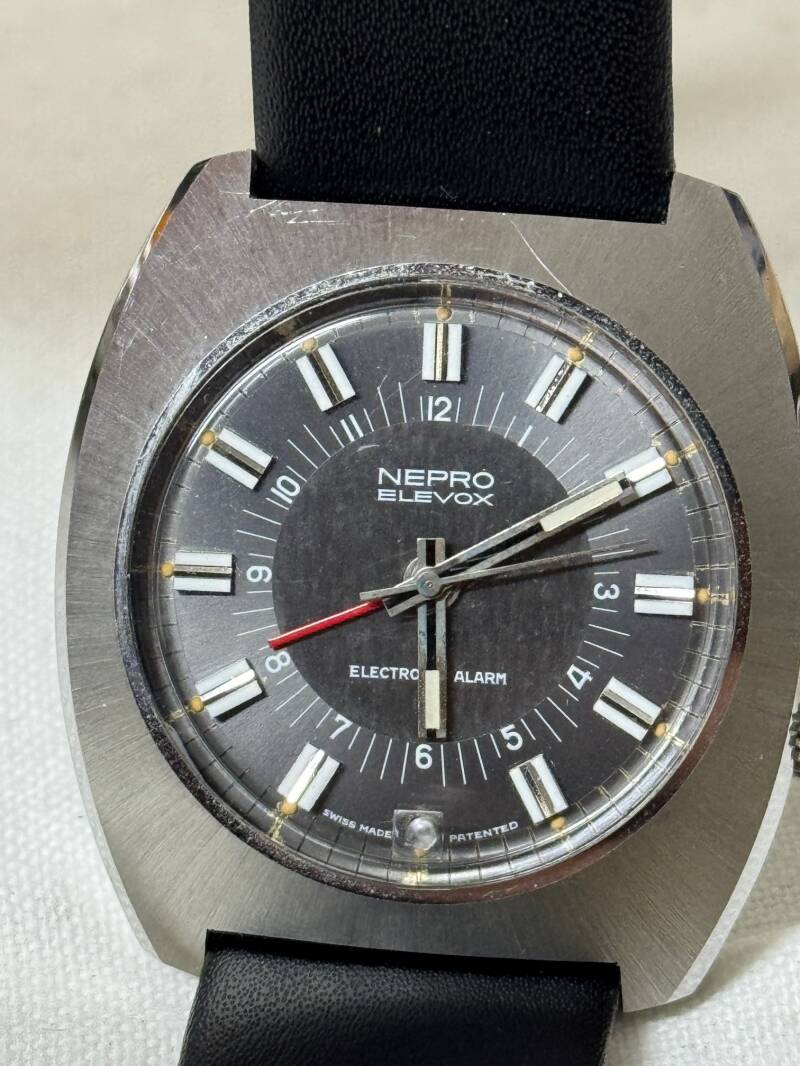
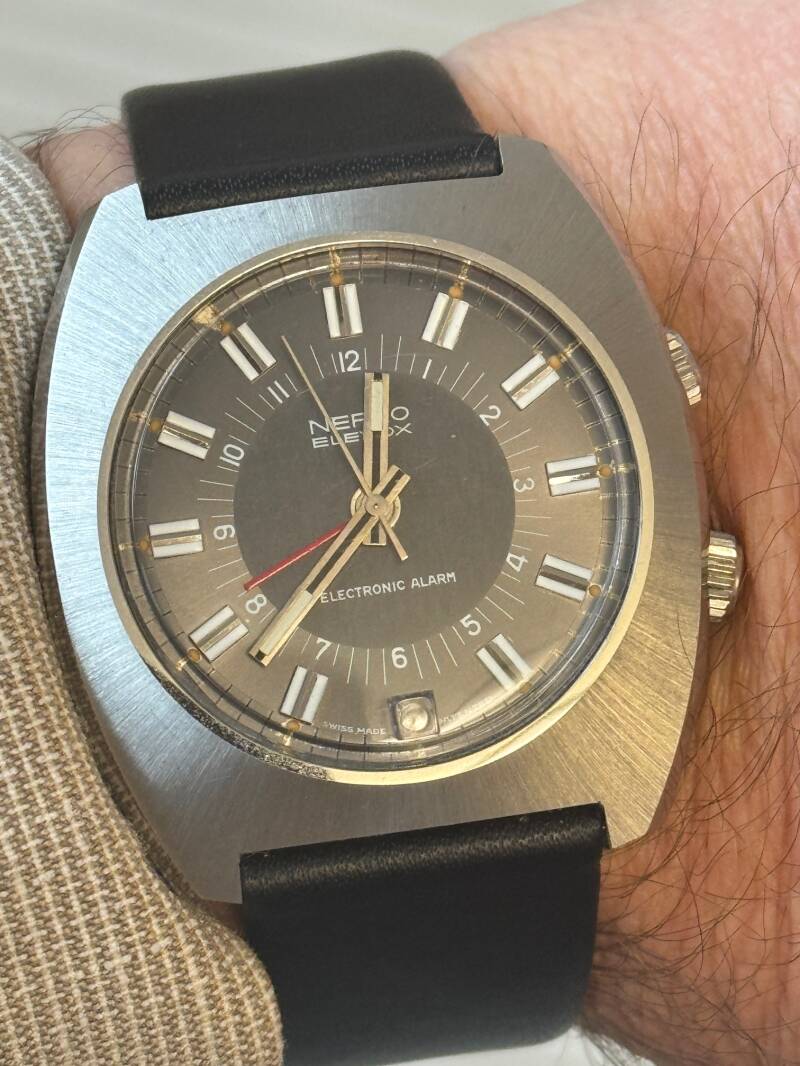
Elevox – When the Crystal Becomes the Speaker
If Memotron focused on automation, Elevox focused on acoustic engineering.
Traditional alarm watches lost volume when worn because the wrist absorbed vibration. Many manufacturers invested heavily in increasing volume. Vulcain’s Cricket, for example, used a double caseback system to prevent sound damping.
Nepro’s solution in Elevox was radical: use the crystal itself as the vibrating membrane.
Unfortunately, the alarm in my Elevox no longer works, so I cannot demonstrate it. But the concept was simple: the electronic generator caused the crystal to oscillate freely, turning the entire front surface into a sound radiator. Because the crystal was not rigidly pressed into the case, it could vibrate without damping.

Someone unfamiliar with the watch might think something is wrong, since the crystal is not firmly fixed. It does not rotate, but if you tap it lightly, you can feel it move. A distinctive detail was the Nepro logo printed on the underside of the crystal at 6 o’clock. On my watch the logo has unfortunately fallen off, so I include a photo of a complete example found online.
Using the crystal as the sound membrane eliminated the need for a separate membrane and reduced case thickness by at least 2 mm.
Inside the Elevox was a manually wound FHF 69 (21,600 vph), paired with the same electronic acoustic principle and the same rotocontact principle as used on Zanzara and Memotron.
While Memotron explored automation, Elevox explored acoustic physics.
Importantly, in Elevox the entire hybrid system was integrated into a standard watch case with a normal caseback. Externally it looked like a classic 38 mm mechanical watch, with two crowns — one for timekeeping and one for the alarm.
In addition, the 'Elevox' was also sold as a pocket watch.

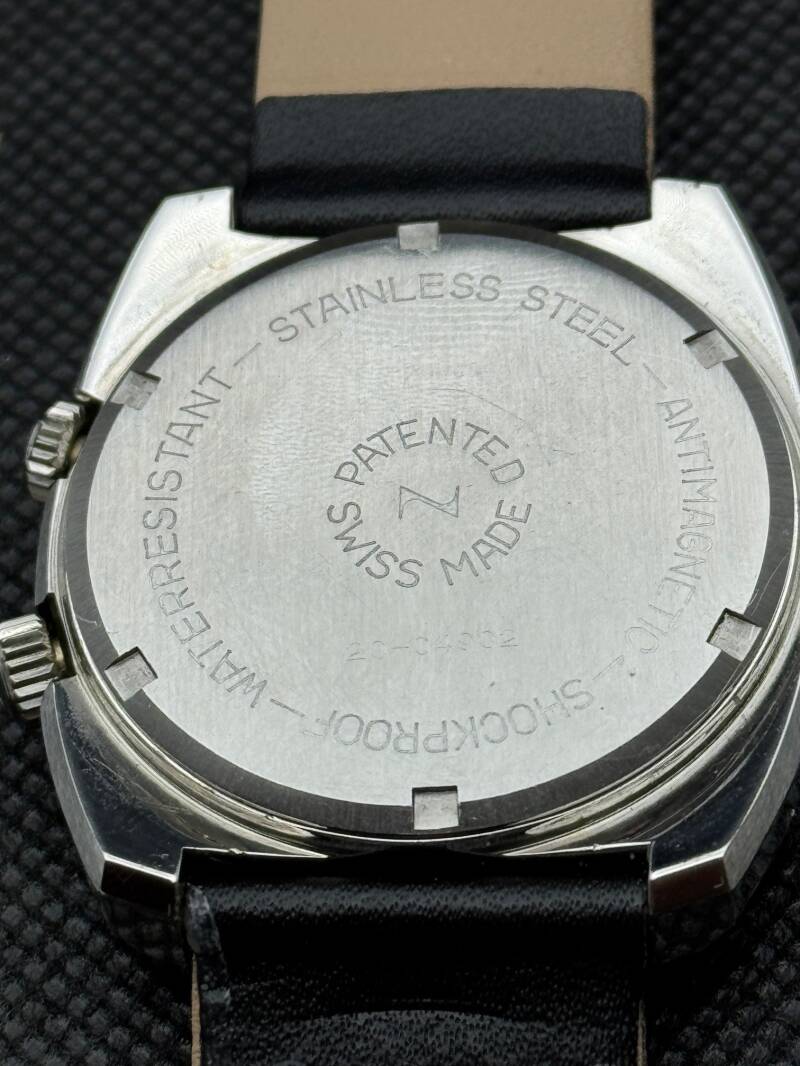
As I already mentioned, unfortunately my Elevox no longer rings. I asked my watchmaker to thoroughly investigate what might be causing the issue. After carefully examining the watch, he concluded that the problem was not mechanical but electronic.
Fortunately, my watchmaker knows several excellent electronics engineers who enthusiastically took on the challenge of investigating the electronic module as a hobby project. After detailed analysis, they discovered that the transistor had failed. That alone would not have been a major problem — if the transistor had not been made from gallium rather than silicon.
Today, gallium-based transistors are used only in extremely specialized electronics, and technically they are practically impossible to replace with standard silicon transistors. To make matters worse, it appears that this particular transistor was produced specifically for these watches, as no similar examples could be found even from the same period.
Which, unfortunately, ultimately means that the alarm function on my watch is permanently disabled and simply cannot be repaired.
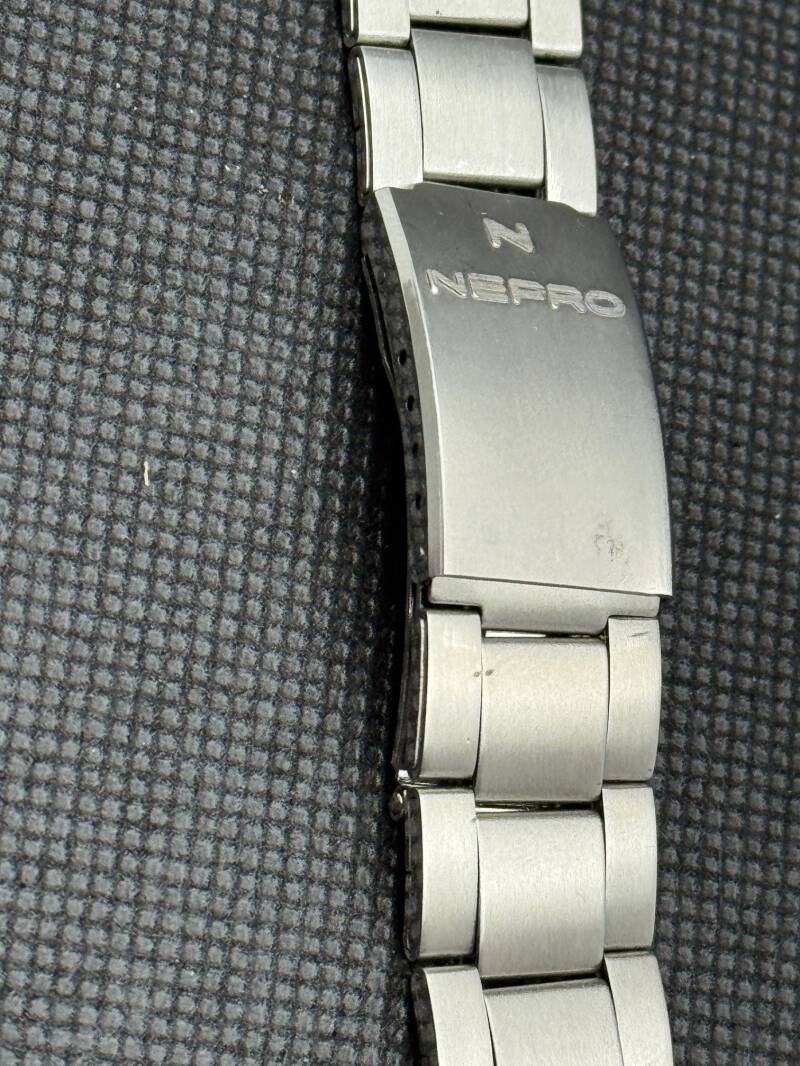
Innovation Beyond Quartz
A 1972 publication introducing Memotron and Elevox also highlighted "Kif Parechoc’s “Permalon” surface treatment for cap jewels — a chemical modification of ruby to prevent oil spread due to capillary action. Unlike traditional epilamization, Permalon was more stable and resistant to ultrasonic cleaning".
Although this detail is minor, it illustrates something important. At Nepro, this was not simply about reacting to quartz. It was about New Products — material experimentation, lubrication science, modularity, acoustic research, and wire-free hybrid engineering within mechanical watchmaking.
This was not desperation. It was experimentation.
Unfortunately, none of the three hybrid models remained in production for long. In 1974, Nepro Introduced a 100% electronic LCD (liquid crystal digital display) wristwatch that flashes the second by pressing on the button positioned on the side of the watch. One year later they already introduced the first solar powered watch. In 1976 Citizen introduced the first digital LCD watch with alarm function (Citizen Quartz Cryston Alarm watch). Amid the digital hype, the hybrid models faded into obscurity.
Today, they are not common on the market. Memotron is the easiest to find, but caution is advised, as alarm modules often no longer function.
Due to the limited supply and demand, it is difficult to determine the real market prices for these watch models. In general, I can say that the cheapest Memotron models in working condition start at around 400 EUR, Elevox watches are more expensive, and the most expensive are the Zanzara models, which can reach prices even up to 1,000 EUR. However, this does not mean that with a bit of a luck you can’t find some of these watches for less — perhaps even significantly less.
Conclusion
From a collector’s perspective, these watches represent:
- Early transistorized acoustic miniaturization
- Wire-free electrical integration in mechanical watches
- Crystal-as-membrane acoustic design
- Modular case architecture with functional isolation
- A clear development line from miniature alarm clocks → Zanzara → fully integrated wrist alarm systems
They are not icons. They are not widely known.They are rarely discussed. But they document a mindset: Swiss engineers attempting to evolve mechanical watchmaking through controlled electronic enhancement, just before quartz would redefine the industry entirely.
In hindsight, these experiments feel like the last confident steps of a tradition trying to innovate on its own terms. And that makes them far more interesting than their market footprint ever suggests.
Add comment
Comments