
Quite some time ago, I wrote a review of the Biatec Leviathan. I was pretty happy with it, so it’s no surprise I stayed on Biatec’s mailing list. They’ve sent out a few updates since then, but nothing really grabbed my attention—at least not until last July. That’s when they announced pre-orders for a brand-new model called the Biatec Fusion. The idea behind the name is fairly straightforward: it’s an integrated bracelet watch—what they describe as “a fusion of the metal bracelet and the watch case into a single whole.”
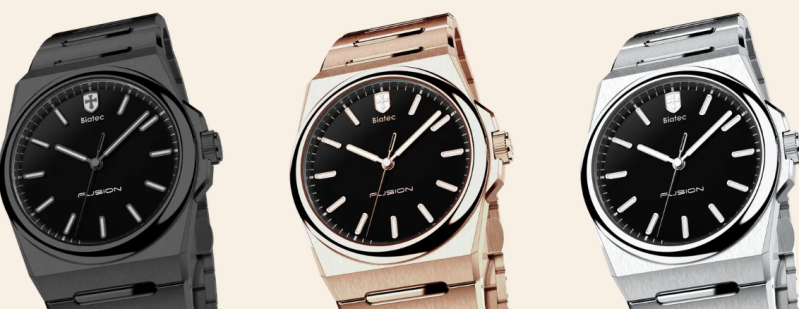
They introduced three standard models, all featuring black dials (black lacquered, highly polished finish), with the differences mainly coming down to the finishing of the case and bracelet. The base model, Fusion 01, is made of 316L steel and treated with a NanTec coating. I already know this combo from the Leviathan, and once again, I can only recommend it—it really works. The case and bracelet are impressively resistant to scratches.
The second model, Fusion 02, comes with a rose gold PVD coating, while the third, Fusion 03, features a black DLC coating. All three models can be seen below (pictures are taken form the official Biatec website).
But the one that really caught my attention was the fourth version—a special edition called the Biatec Fusion First Edition 50, limited to just 50 pieces. At its core, it’s similar to the Fusion 03, meaning a black DLC-coated steel base. The key difference lies in the dial—and everything happening on it. The main attraction here is the meteorite dial, specifically a “Black Muonionalusta meteorite dial (classified as a fine octahedrite, type IVA (Of), which impacted northern Scandinavia, west of the Sweden–Finland border, about one million years BCE).” On top of that, you get a neon yellow seconds hand and a matching neon yellow serial number applied directly to the dial. More on that later.
Since the First Edition felt significantly more special, I decided to go for it—reserved one and paid the deposit.
At the time of ordering, delivery was expected in early February this year. But things didn’t quite go according to plan. Production hit a snag, and the delivery window was first pushed to early March. In early March, they did announce the watches were about to ship and asked for the remaining balance—but then things got delayed again.
I received a notice saying that the bracelets they had received didn’t meet their standards, so they had to reject them. Shipping would resume once a corrected batch arrived. As a gesture of apology, they promised a small gift—Biatec sunglasses.
Well, nearly nine months after placing the order, the watch finally arrived.

And I have to say—the package was pretty generous. Alongside the hefty watch box, there was indeed a nicely presented box with quality sunglasses, plus a bar of dark chocolate on top. One thing worth mentioning, though: the watch documents come in a separate envelope that’s actually larger than the watch box (since the documents themselves are oversized). That’s honestly quite impractical. I like to keep all documents inside the original box, but here you’d have to fold them, which basically means damaging them. They could easily have made the documents slightly smaller and avoided the issue altogether.


Unfortunately, I was far less impressed with the watch itself—especially the bracelet. Let me be clear right away: this isn’t about poor quality. The real issue is that the watch, and particularly the bracelet, looks quite different from what the render images had promised.
To give you a better idea of where my disappointment comes from, I’ve included the original render images below, taken directly from the official website. I’ll also quote their official description of how the watch is supposed to look:
“Black DLC-coated 316L stainless steel case, brushed and polished finish; black DLC-coated stainless steel bracelet with quick-release spring bars, brushed finish with finely polished middle parts and edges, width 29.00/20.00 mm, butterfly clasp fitted with a micro-adjustment mechanism which allows the wearer to adjust the length by up to 2.2 mm per side – and 4.40 mm in total. Length: 175.00 mm, suitable for wrists up to 210.00 mm.”


The reality, unfortunately, is quite different. The DLC coating seems to have been applied so heavily that it completely washes out the contrast between brushed and polished surfaces. As a result, the entire case and bracelet look uniform—and not in a good way. The bracelet, in particular, ends up looking almost like it’s coated in plastic.
The butterfly extension is only partially coated, and when fully extended, the exposed untreated steel underneath shines through in a rather unattractive way. On top of that, the quick-release spring bars aren’t DLC-coated at all (even though the render images clearly suggest they should be). In addition I ask myself why a quick-release system is needed here. There are no additional straps offered and the quick-release system only gives it's full value when you want to change between straps often.


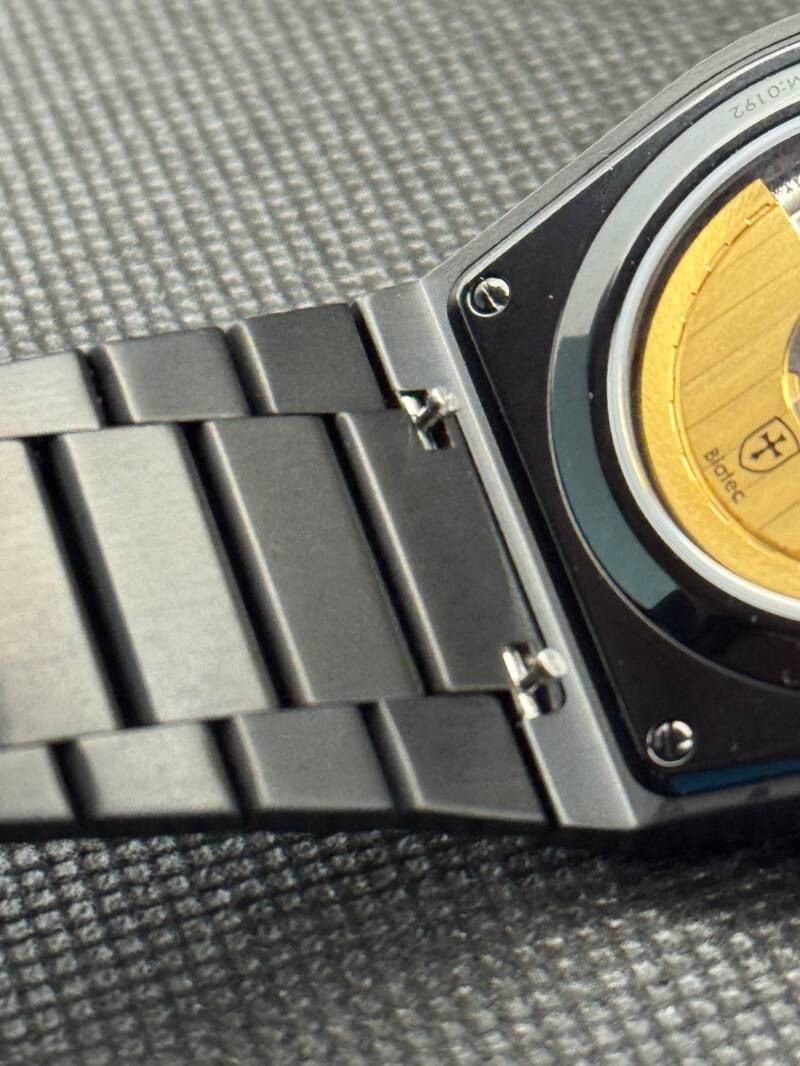
I’m trying to comfort myself with the thought that such a thick DLC coating will probably offer better protection against scratches…
As for the meteorite dial, I have to admit it’s also not quite what I expected either. I was anticipating a slightly more grey tone, but in reality, it’s completely black. That said, this mismatch between expectation and reality isn’t down to misleading render images—they actually show the black color quite accurately—but rather my own prior experience with other meteorite dials I’ve seen on different watches.
Apparently, the meteorite used here has a very high carbon content, because it genuinely looks almost like charcoal. The downside of that deep black tone is that, in normal lighting, you can barely tell the dial is anything special. However, once you get it out into direct sunlight, it finally reveals the kind of richness and texture you’d expect from a meteorite dial.


Since I’m already on the topic of the dial, it’s only fair to briefly touch on the rest of its elements. Pretty much everything revolves around black. You get an applied 3D logo and hour indices, brushed with finely faceted polished edges and coated in black gold. The hour and minute hands follow the same idea—brushed, with polished facets, also coated in black gold. And on top of all that, everything is treated with Super-LumiNova® Black on the indices and hands. So yes—black on black, with even more black layered on top.
To be fair, I was fully aware even before buying that legibility might be an issue with this watch. And I was right. The best way to describe the problem is probably through my wife’s comment when she saw it: “What is that watch you’re wearing today where only the seconds hand is moving? How do you even tell the time?” Legibility is highly dependent on how much light hits the dial. In slightly dimmer environments, the watch is practically unreadable, while in brighter conditions, it becomes reasonably usable. BTW, it seems that standard models have much better legibility!
Black lume is technically still lume, but in my experience, none of the watches I’ve owned with black lume have ever really emitted much light—and this one is no exception. With quite a bit of effort, I did manage to capture a photo showing how the watch is supposed to glow in optimal conditions, but don’t let that fool you. In real life, the black lume is of very limited use. The part that glows the longest and strongest is actually the Biatec logo—which, of course, isn’t particularly helpful when you’re lying in bed at night wondering how much longer you can sleep.

Let’s go back to the bracelet. In terms of shape, it tapers nicely from 29 mm at the top down to 20 mm at the clasp, which works really well visually. It’s also worth praising the inclusion of an extension system—something you don’t often see on butterfly clasps.
Because of that extension, I initially removed four links (each link is about 7 mm wide). Taking links out is fairly straightforward, although you do need a relatively small screwdriver—it’s a bit of a shame one isn’t included with the watch. Working with screws, especially black-coated ones, is always a bit stressful, as it’s very easy to damage or at least scratch them. Fortunately, Biatec doesn’t use any thread-locking compound, so the screws are relatively easy to undo.
As it turned out, removing four links was too much for my wrist, which is just under 19 cm. Even at times when my wrist is at its smallest (and it does fluctuate quite a bit throughout the day), I still had to keep the extension engaged. Quite often, I even needed the full extension—exactly where the unfinished DLC coating on one side became particularly noticeable and, frankly, annoying. In the first wrist shots, you’ll see the watch with four links removed.
I later added one link back and now wear it with three removed—those are the wrist shots you’ll see towards the end. That said, even with three links removed, I occasionally run into another issue: when my wrist expands a bit, the extension can sometimes activate on its own and extend unintentionally. What’s especially odd is that it’s always the same side—the one with the partial DLC coating. I’m not sure whether this is by design or if it’s a flaw with my particular bracelet, but either way, I find that kind of self-adjusting behavior more annoying than useful.

Below you can check out the wrist shots I mentioned earlier. One thing I really have to praise is how well the watch wears. I was slightly concerned that the 39 mm diameter might feel a bit too small for my wrist, but that worry turned out to be completely unfounded. With a 47 mm lug-to-lug and just 9.2 mm thickness, it sits incredibly comfortably on the wrist, and the integrated bracelet gives it a very compact visual presence.


I was actually quite pleasantly surprised by how thin the watch is, especially considering it houses the Sellita SW300 TOP grade automatic movement—specifically the no-date version 1b. That certainly helps keep things slim, as the absence of a date complication allows for a slightly thinner movement, and consequently a thinner watch.
Most modern watches that come in under 10 mm tend to rely on Miyota 9xxx series movements, so seeing a Sellita inside such a slim case is a bit of a surprise—in a good way.
Since I mentioned this is a no-date SW300, it’s worth pointing out that there’s no “dummy” crown position here. You know how some brands use a date-capable movement but simply omit the date display, leaving you with an extra crown position that does nothing? That’s not the case here. This is a proper sub-variant of the movement where the date function isn’t present at all.


After the first two days of continuous wear, I can report that the watch is running at about -8 seconds per day. That’s perhaps a bit more than you’d expect from a TOP-grade Sellita, but I’d anticipate it settling in and improving slightly after a few more days on the wrist.
To wrap things up—credit where it’s due. Biatec definitely deserves recognition for having the courage to develop a completely new model, and especially for launching it alongside a special edition. The timeline clearly shows they ran into quite a few challenges along the way, and it seems they didn’t manage to resolve all of them perfectly. As a result, the watch unfortunately didn’t fully live up to its original vision—at least not in this particular execution.
I should stress that my opinion is limited specifically to the black DLC version. I genuinely believe that the standard Biatec Fusion 01 on a steel bracelet is likely a much more refined product overall—and on top of that, significantly more affordable. That said, “affordable” is relative here. The base model comes in at €1,790, while the Biatec Fusion 02 and Biatec Fusion 03 are priced at €1,890. The Biatec Fusion First Edition, however, jumps all the way to €3,490.
To be fair, the entire First Edition was practically sold out during the pre-order phase, when it was priced €1,000 lower. As far as I know, by the end of December only a handful of pieces were still available (serial numbers 27, 32, 37, 43, 46, and 47). At one point it even looked like everything was gone, although it seems you can still pick one up now—my guess is that a few pre-order customers may have backed out.
I’m genuinely curious to see where the Fusion line goes from here. My bet is that Biatec will expand the range of dial options, especially on the steel versions with the NanTec coating. Either way, I wish them the best of luck moving forward.
And to close on a positive note—I have to thank their sales manager, Jana Kožarova, who was extremely responsive throughout the entire process. She replied quickly to all my questions and even proactively kept me updated on the production status of my watch.
Add comment
Comments