
Introduction:
As a dedicated collector of mechanical alarm watches, I naturally keep a close eye on any new developments in this niche. So it wasn't surprising that almost two years ago I noticed Ball heavily promoting a new model from their Roadmaster collection on their website, called the Roadmaster M Model A. It was advertised as an alarm watch powered by a proprietary automatic movement called the BALL RRM7379.
When it comes to collecting alarm watches, my primary interest is owning watches with different movements rather than different watch models powered by the same movement. In other words, once I own a watch with a particular movement, I can tick that movement off my list. After that, another watch using the exact same movement becomes much less interesting to me, although I can still appreciate different case designs or other unique features.
Naturally, a watch supposedly powered by a completely new alarm movement immediately caught my attention. At the same time, I was somewhat skeptical about whether it really was an entirely new movement. My skepticism came from the fact that the watch was limited to just 333 pieces, and at a price of €5,500 (+ VAT), it was difficult to see how the economics of developing a completely new in-house movement would make sense.
An even bigger reason for my skepticism was the render of the watch's caseback. The watch has a sapphire display back, allowing you to see the movement, and what I saw looked remarkably similar to the good old A. Schild AS5008 alarm movement. The description of how the watch operated only reinforced my suspicion that this was, in fact, an AS5008-based movement.
A watch that was simply another AS5008 variant wasn't particularly interesting to me, so I contacted Ball and asked for clarification about the movement and its relationship to the AS5008. Surprisingly, I received a reply very quickly. They explained that the watch did indeed feature a manufacture movement and not an AS5008, because their watchmakers had "completely redesigned the alarm module and the GMT complication." Indirectly, they were therefore acknowledging that the movement wasn't entirely in-house, but rather a heavily modified interpretation of the AS5008 concept. They also informed me that, should I decide to purchase one, the watch was not kept in stock. Every piece was assembled only after an order had been placed. As a result, the delivery time was approximately three months after both ordering and paying for the watch in full.
Before I continue, I should probably explain a few things about the AS5008 movement itself.


The standard AS5008 has two separate mainsprings: one powers the timekeeping, while the other powers the alarm. Both are wound automatically by the same rotor, and both can also be wound manually. The standard AS5008 features both a date and day-of-the-week display, with all these functions controlled via the upper crown positioned at 2 o'clock. The lower crown, located at 4 o'clock, is used to set the alarm hand and to switch the alarm on and off.
The standard AS5008 was developed in the early 1970s and was used by a large number of watch manufacturers. Not long after its introduction, modified versions appeared where the day-of-the-week complication was replaced by either a moonphase complication (these versions are quite rare) or, much more commonly, a GMT complication.

Following the Quartz Crisis, AS5008 movements almost disappeared. However, with the revival of mechanical watches—including mechanical alarm watches—a large number of new models appeared using AS5008-based movements with a GMT complication. Here are just a few that I've owned or still own in my collection: Franck Muller Big Ben with the Jacquet 59 movement (on the left photo), Graham Swordfish Grillo GMT with the LJP5900 movement, Maurice Lacroix Masterpiece Globe GMT Réveil (on the right photo), and Baume & Mercier Capeland GMT World Time Alarm.
So, a mechanical alarm watch with a GMT complication is by no means something unusual or particularly rare.

Given all this, you can probably understand why I hesitated before buying the Ball. I also tried to gather as much information as possible from respected watch review websites and YouTube channels. I have to admit, I was quite disappointed with what I found. I didn't come across any genuinely useful information. Even worse, many reviewers published obvious inaccuracies.
For example, I read claims that the movement wasn't similar to anything else on the market, that the alarm was "probably" manually wound, or that combining an alarm with a GMT complication was practically a market first. The only review that correctly pointed out the movement's AS5008 roots was published on fratellowatches.com.
Still unsure whether the watch was truly different enough to deserve a place in my collection, I decided to analyze exactly what made it different. I focused on Ball's statement that "our master watchmakers redesigned the alarm module and the GMT complication."
The first difference was actually staring me right in the face. Every previously mentioned AS5008 GMT watch implements the GMT complication by replacing the day-of-the-week display, while still using the same display principle as the original day or date indication. In other words, the GMT hours are printed on an internal rotating disc, much like a date wheel, with the selected hour displayed through a small window. None of these watches, however, has a true GMT hand—which the Ball Roadmaster does. So this is clearly one of the modifications Ball made to the GMT complication.

The alarm modification is more subtle.
Instead of using a traditional alarm hand like every other AS5008-based watch, the Ball Roadmaster uses a rotating alarm disc with a printed pointer indicating the alarm time. At first glance, it actually looks just like a conventional hand, so it's easy to miss.
Ball also redesigned the striking mechanism itself. Instead of the hammer striking a pin, as on all traditional AS alarm movements, the watch uses a sound spring that surrounds the case.


Purchase and the Complications Along the Way:
After thoroughly analyzing the movement, I concluded that Ball had modified the alarm movement enough to make it genuinely different and deserving of a place in my collection. So I decided to buy one.
To my surprise, I quickly discovered that the watch couldn't be purchased anywhere except directly from Ball's official online store. None of Ball's authorized dealers had it, and it wasn't available through the grey market either. I did find one on Chrono24 in Malaysia, but the seller was asking about €1,000 more than Ball's official retail price—probably using the same logic as Rolex, assuming someone would gladly pay a premium to get it immediately.
So, in the middle of November 2025, I placed my order directly through Ball's online store.
When ordering the watch, every buyer can choose between two different lume configurations: Classic or Rainbow.
Ball is well known for the exceptional nighttime visibility of their watches, and this alarm model is no exception. The dial and hands are illuminated using tritium gas tubes. The Classic version uses "only" two colors—yellow and green—while the Rainbow version uses a much wider range of colors. In both versions, however, the bezel uses Super-LumiNova rather than tritium tubes.
I chose the Rainbow version.

The next step is selecting the serial number. Every customer can choose from the remaining available numbers between 1 and 333. When I placed my order, just under half of the serial numbers were still available.
The watch is only offered on a bracelet. I also ordered the optional rubber strap with a brushed pin buckle, which cost approximately €200. I placed the order, paid for both the watch and the strap, received confirmation that my order had been accepted, and was told to expect delivery in the middle of February. I also paid the VAT at the time of purchase.
At the beginning of February, Ball informed me that due to delays in receiving certain components, delivery of my watch would unfortunately be postponed until the end of May. I sent Ball a rather unhappy email, pointing out that under consumer protection regulations they should really compensate customers with interest, considering they required full payment upfront. Instead, they offered me an additional leather strap with a pin buckle free of charge as compensation. I accepted the offer.
I was pleasantly surprised when, during the last week of February, I suddenly received a FedEx tracking number by email. They had actually shipped my watch and the very next day it arrived at customs. That's where the first real complication began.

The invoice Ball included with the shipment listed only the watch. Neither of the straps appeared on the invoice. Even though the shipment was sent under DDP (Delivery Duty Paid) terms, customs still requested my invoice together with proof that VAT had already been paid, which is standard procedure. The problem was that my payment confirmation didn't match Ball's invoice.
I wasn't even sure whether Ball had actually shipped just the watch or had included the straps as well. I contacted Ball and received an unofficial reply saying that everything had been shipped—but that I should "not mention the straps to customs."
Since I couldn't explain to customs why I had paid more than the declared value of the shipment, I sent them a copy of my original order showing everything I had purchased, a copy of Ball's email confirming that one strap had been added free of charge, and my payment confirmation. Based on all these documents, customs finally cleared the shipment, and I received the watch the following day.
The Problems Escalate:
Naturally, I unpacked the watch right away. I was pleased to see that everything I had purchased—and everything I had been promised—was actually in the package. I liked the watch immediately and started checking whether everything worked as it should. I set the time, date, and alarm, wound both mainsprings, and tested the alarm. I really liked the sound—it was loud, pleasant, and exactly what I had hoped for.


Next, I adjusted the bracelet. In principle, this isn't difficult, but you do need a very small screwdriver. I barely managed to find one that fit. Fortunately, the screws aren't glued, so with the proper tool, resizing the bracelet is straightforward. I was a little surprised, though, that with my almost 19 cm wrist I only had to remove two links. That means the full bracelet really only fits wrists up to a bit over 20 cm.
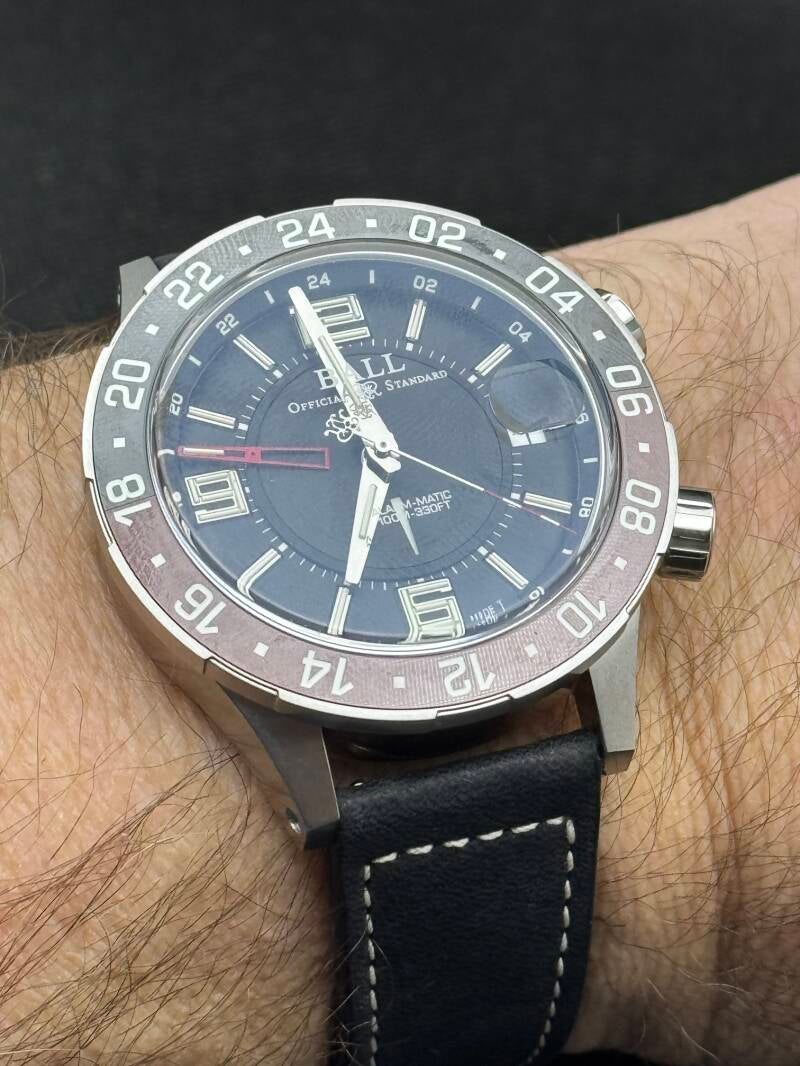
I also tried fitting the leather strap. Even the lugs are unusual—they use screws rather than spring bars. Again, it's not difficult, but this time you need two screwdrivers. I liked the watch on the rubber strap as well, but decided to keep it on the bracelet for the time being.
Finally, I set the alarm for the following morning, put the watch on my wrist, and considered my initial inspection complete. Well... the next morning brought an unpleasant surprise. The watch didn't ring.

My first thought was that I had accidentally pushed the alarm crown back in during the night, thereby deactivating the alarm. But that wasn't the case—the crown was exactly where it should have been. Then I thought perhaps the alarm mainspring had run down. I manually wound it, tried activating the alarm, but it remained completely silent. I spent the entire day trying different ways to bring the alarm back to life, but nothing worked. The watch simply refused to ring anymore.
I contacted Ball again. They responded quickly. At first, they tried convincing me that I simply didn't know how to operate the alarm, but eventually I managed to persuade them that the alarm genuinely wasn't working. A few days later, the head of their after-sales department contacted me personally and sent me a FedEx shipping label so I could return the watch to Switzerland. I packed the watch—without the box or documents, although I did have to include a copy of the warranty card—called FedEx to collect the parcel, and at the beginning of March the watch was on its way back for repair.
The watch remained at the service center until the beginning of June. Then the head of after-sales contacted me again to arrange a convenient date for shipping the watch back. On the agreed date, the watch was shipped. This time, however, it wasn't sent via FedEx Express but through FedEx's standard service. A few days later it arrived at our customs.
FedEx's customs broker once again requested all the documentation relating to the shipment. I provided everything from the original import, including the original tracking number, my correspondence with Ball confirming that the watch had been returned under warranty, and the tracking number used when I shipped it back to Switzerland. I was convinced customs would clear the package within minutes. I couldn't have been more wrong.
Five days passed without any update, so I contacted FedEx to ask what was happening. Their answer was simply that customs were reviewing something and that they would let me know once there was any news. Then things really started getting complicated.
Customs requested a whole series of additional documents, including the original invoice from the first import, proof of payment, the watch's serial number, and more. The biggest issue once again turned out to be the mismatch between the original invoice and my payment confirmation.
The documents that had been sufficient during the original import were suddenly no longer acceptable because, at that time, I had submitted my order confirmation rather than Ball's official invoice. After more than a week of exchanging emails, I finally learned from FedEx's customs broker what the real problem was. When I sent the watch back for warranty repair, it had not been declared as a temporary export. Instead, it had been declared as a regular export with a declared value of just €100. On paper, I had therefore permanently exported my watch from the European Union—as if I had sold it outside the EU—and was now importing it back as a completely new import.
Ball had incorrectly declared the shipment when preparing the FedEx paperwork for the return!
After almost three weeks, FedEx's customs broker finally managed to get in direct contact with the customs officer handling my case. The customs officer agreed to physically open the parcel and inspect the watch. He decided that if the serial number matched the documents from the original import, he would release the shipment. Fortunately, the serial number is clearly engraved on the back of the watch. I honestly don't know how this would have ended if the serial number had been hidden somewhere inside the case.
After more than three weeks, I finally had my watch back.
Nobody was happier than I was. And nobody was more shocked than I was when, during my very first test, I discovered that the watch still wasn't working properly.
This time the alarm actually rang, but it didn't operate correctly. More specifically, the alarm is supposed to go off when the hour hand reaches the alarm position. The opposite is also true—if you manually rotate the alarm disc until it reaches the hour hand, the alarm should also start ringing. If you continue rotating the alarm disc forward (or better say counterclockwise as this is the only allowed way), the alarm should immediately stop ringing. In fact, that's one of the intended ways of silencing the alarm.
During my initial tests back in February, the watch behaved exactly like that. Now, after returning from service, it didn't. Once the alarm started ringing, it continued ringing until it completely ran down, no matter how far I rotated the alarm disc away from the hour hand. The only way to stop it was by pushing the alarm crown back in. I could probably have lived with that.
But a few hours later an even more serious problem appeared.
I had set the alarm for 6:00. Earlier that day, while setting the alarm for 6.00, the alarm disc passed the hour hand, the alarm rang as expected, and I stopped it by pushing in the crown. At 9:00 PM I pulled the crown back out, so reactivating the alarm for the following morning at 6:00.
What a shock... The alarm suddenly went off at 11:25 PM?! I deactivated it by pushing in the crown again, manually rewound the alarm spring, and activated it once more.
This time the alarm remained silent, so I assumed everything was finally set correctly. But at 6:00 the next morning...
Nothing happened. The alarm didn't ring. And worst of all, it was completely dead again—exactly like the first time. No matter what I tried, I simply couldn't get it to ring again.
Completely furious, I wrote to Ball telling them that this had become utterly ridiculous and that I was seriously considering returning the watch and demanding a full refund. Sending it back for another repair was no longer an option after my previous experience.
The weekend came, so I didn't receive any reply from Ball. By the end of the weekend, I decided to take the watch to my watchmaker friend instead. I was convinced the problem was related to the mechanism that activates and deactivates the alarm, which shouldn't have been particularly difficult to diagnose. Throughout all this I had continued wearing the watch—I simply wasn't using the alarm anymore.
On Sunday evening I took it to my friend. And just as I was about to demonstrate everything the watch wasn't doing—but should have been doing—I was completely stunned. The watch worked perfectly. The alarm rang exactly as it should. When the alarm disc reached the hour hand, it started ringing. As soon as I rotated the alarm disc forward, it stopped ringing exactly as expected. Everything worked flawlessly. So I took the watch back home and continued wearing it. I've now been wearing it continuously for the past three weeks, setting the alarm every day, and every morning it rang exactly when it should. Every now and then, it still happens that when I'm setting the alarm and the alarm disc passes the hour hand, the alarm starts ringing and refuses to stop immediately. But the important thing is that it no longer rings at random times, and it does ring when it's actually supposed to.
Even though - I've now been using the watch daily for three weeks, I still don't completely trust it. If I absolutely had to wake up at a certain time, I would definitely set another alarm as a backup.
And Finally, the Review:
Now that I've had some time to sleep off all the frustration this watch has caused me, and now that it has finally been sitting on my wrist and (mostly) functioning normally for the past three weeks, it's finally time to write down some actual impressions of the watch itself.
Dimensions:
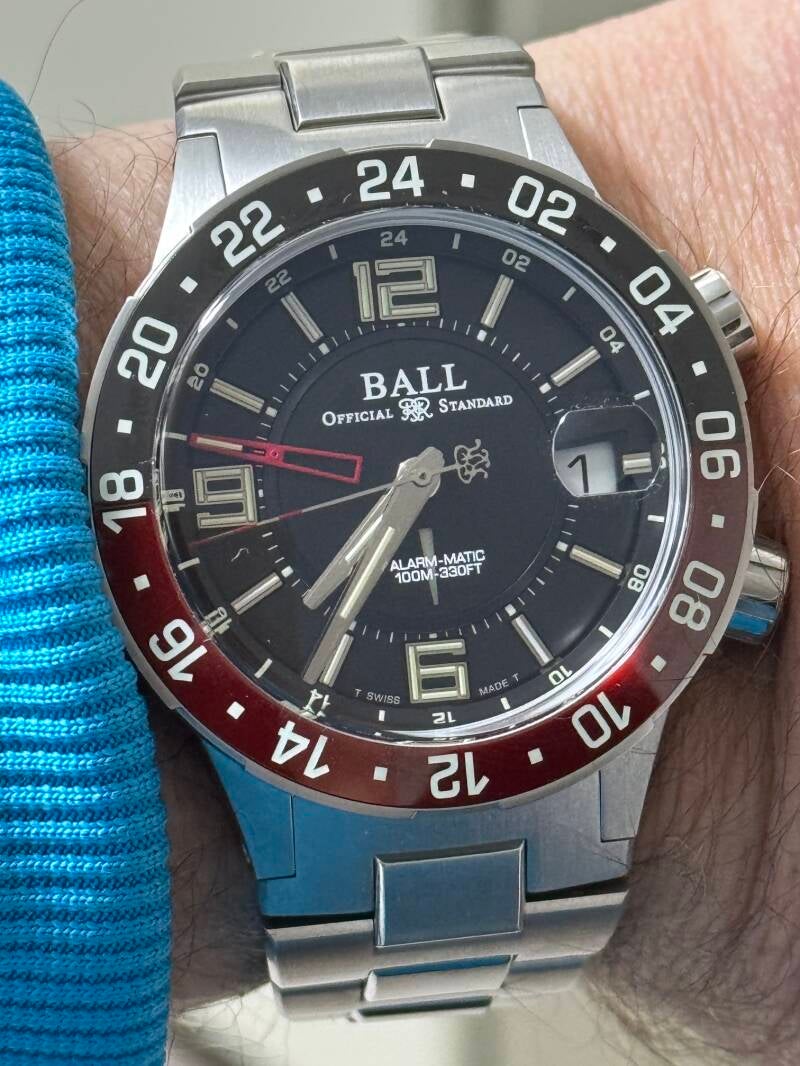
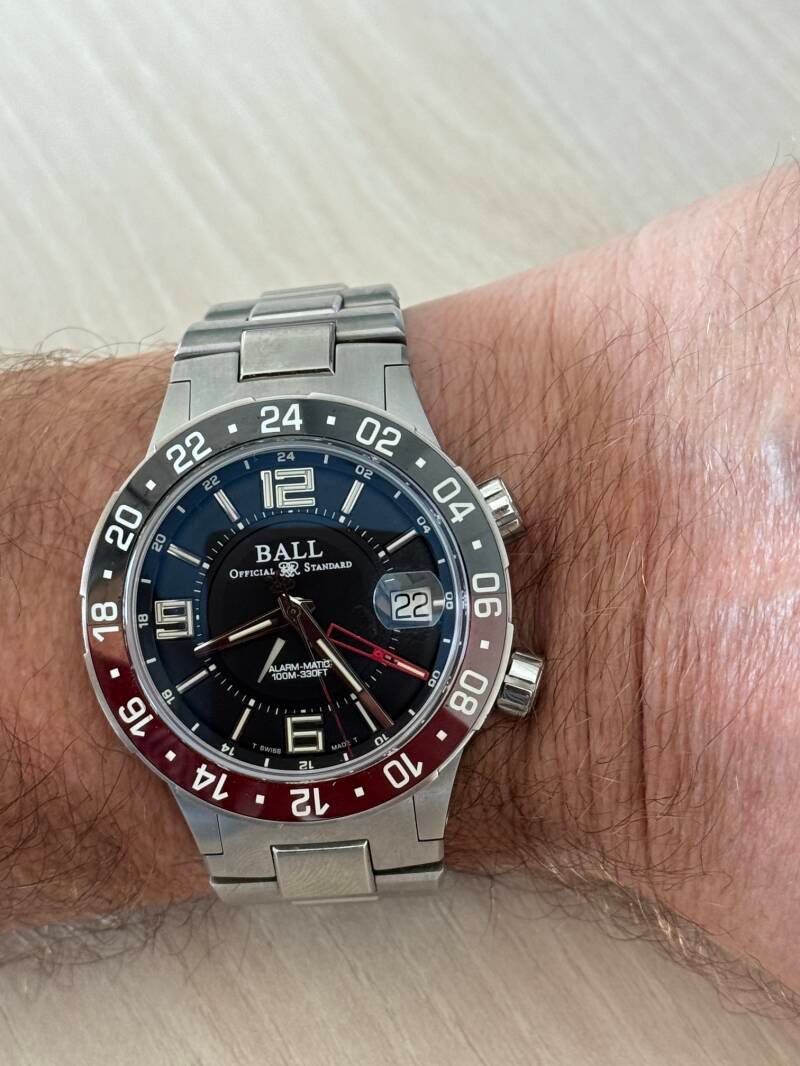
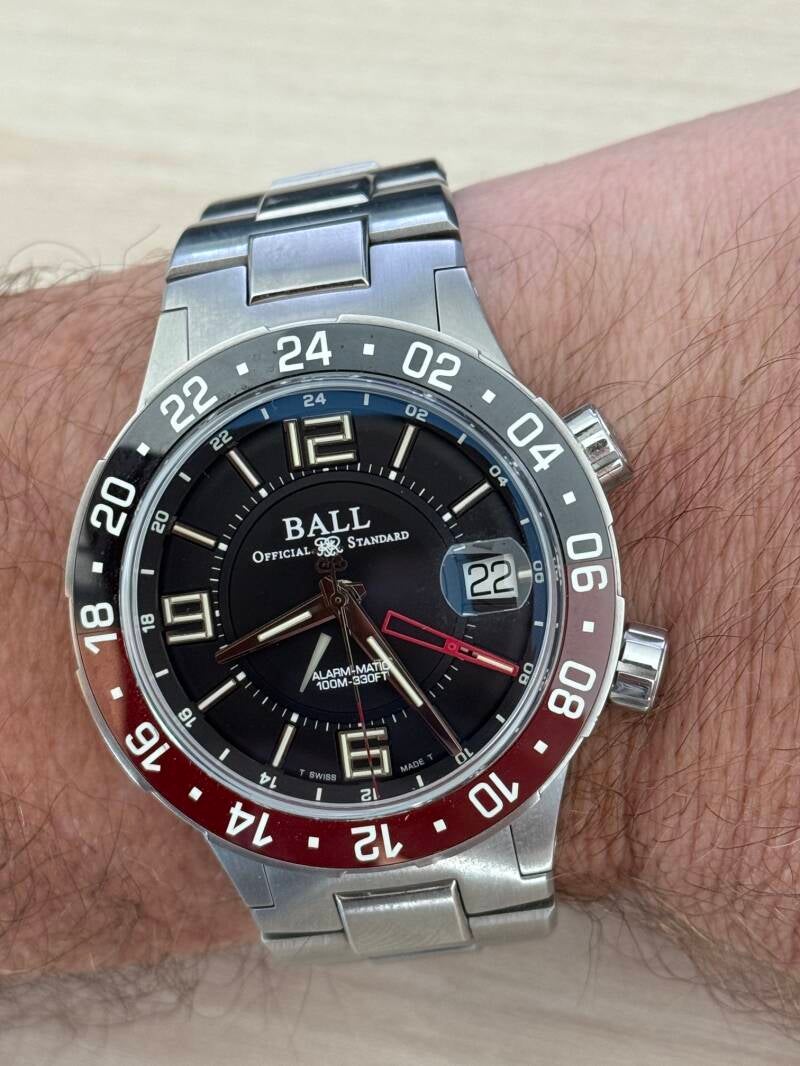
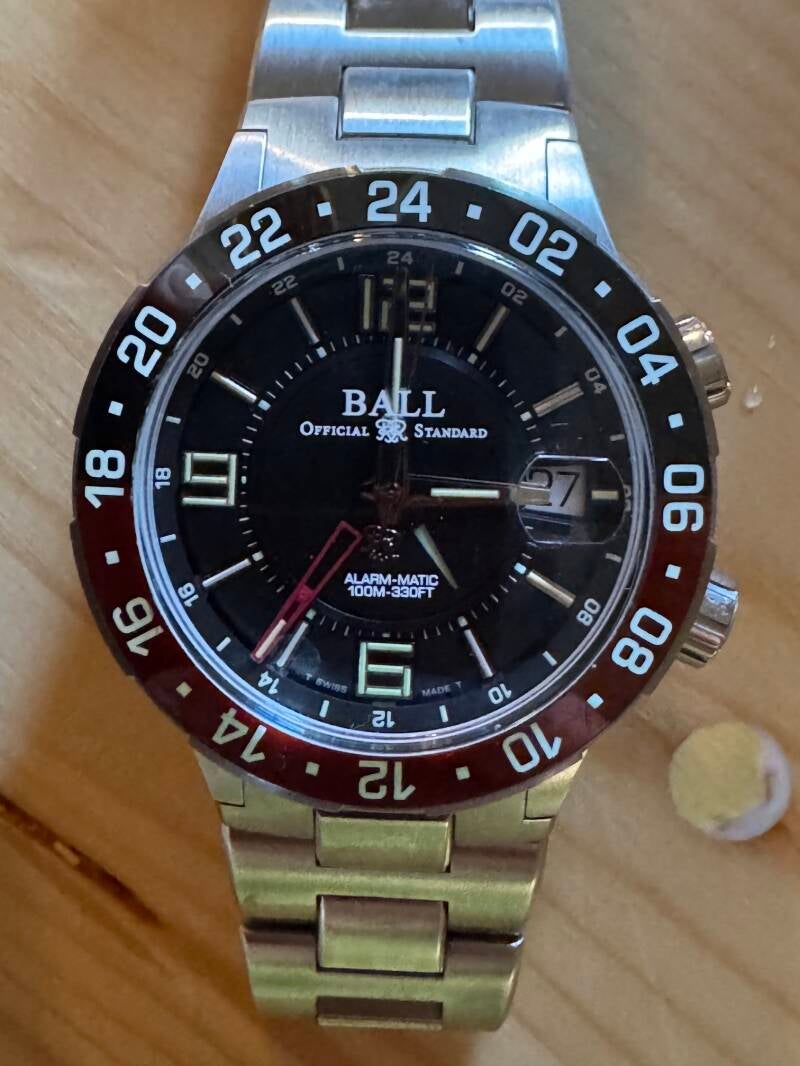
The official case diameter is listed as 41 mm, but honestly, you can throw that figure straight into the bin. Yes, the case itself measures 41 mm, but sitting on top of it is a bezel that's considerably wider—between 43 and 44 mm, depending on where you measure it. Visually, the watch wears as large as the bezel, not the case. Add to that the two fairly substantial crowns, and the overall appearance is nothing like what you'd expect after reading "41 mm."
It's not all bad, though. The lug-to-lug distance is just 49 mm, and the lugs are nicely curved. Together, that makes the watch considerably more wearable than the raw dimensions might suggest. The watch is just over 15 mm thick, although a significant part of that comes from the highly domed crystal, which clearly protrudes above the bezel. Personally, I think it sticks up far too much.
Materials and Build Quality:
The case and bracelet are made from 904L stainless steel, which is supposedly more scratch-resistant.
The case sides are brushed, while the integrated bracelet is polished and absolutely excellent. The whole package feels very cohesive.
Normally I'm not much of a bracelet person—which is why I also bought the optional rubber strap—but on this watch the bracelet doesn't bother me at all. None of the usual bracelet annoyances are present. It doesn't pull hairs, the watch is perfectly balanced on the wrist, and it never feels top-heavy. Even at nearly 170 grams, it doesn't feel particularly heavy. It's genuinely an excellent wearing experience. Even though watch fits nice also on both straps, not once have I considered swapping it onto one of the straps.
That said, despite the 904L steel, I've already managed to pick up quite a few scratches in just over three weeks. So no, even 904L isn't indestructible.
Crystal:
The sapphire crystal is rather unusual.
Besides protruding well above the bezel, it also features a magnifying date cyclops. I'm generally not a fan of cyclops lenses, and this one doesn't change my opinion. It's very large. I have to admit, though, that when viewed from the correct angle it does its job exceptionally well. The date is very easy to read—even for my aging eyes without reading glasses. The downside is that it's only readable from that correct viewing angle. From almost any other angle, the date becomes difficult to read.
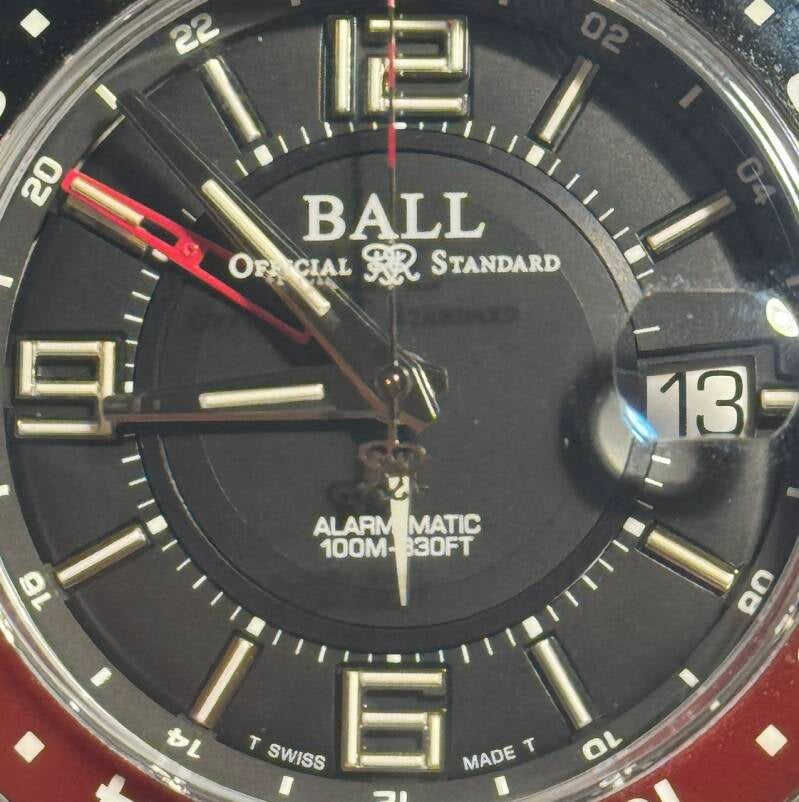
Another interesting feature is that all the dial text has actually been printed on the underside of the crystal rather than on the dial itself. The reason is obvious: the watch uses a rotating alarm disc rather than an alarm hand. If the text were printed on the disc itself, it would rotate together with the alarm setting.
I wrote a bit more about problems of text writting on rotating discs in my review of the JLC Memovox Cal. 601, since JLC is well known for using alarm discs.
Printing the text on the crystal does have one drawback.
All the hands move underneath the printed text, meaning the text partially obscures them.
Most of the time this isn't a problem, but it can become slightly annoying when the hour or minute hand is between roughly 10 PM and 2 AM, because that's exactly where the printed text covers the luminous portion of the hands.
The lower text—"Alarm-matic / 100m 330 Ft"—is also somewhat unfortunate because it sits right where you most often set the alarm, around the 5:00 to 7:00 area.
The Crowns:
Well...
This is one area where I came across an incredible amount of nonsense while reading and watching reviews.
First of all, both crowns screw down. I even saw one review complaining that only the upper crown screwed down. That's simply incorrect. Ball explicitly states that both crowns must be screwed down in order to maintain the watch's rated 100-meter water resistance.
The alarm crown even features a red warning band that's visible whenever the crown isn't fully screwed in.
It's also untrue that the time-setting crown is significantly larger than the alarm crown. Both crowns are exactly the same size, and both feature the RR logo.
I also read complaints that winding the alarm is relatively difficult because the large bezel gets in the way—supposedly an inconvenience since the alarm needs frequent winding. Again, I find those comments rather amusing.
The alarm winds just as easily as the main movement. More importantly, though, the alarm is also wound automatically, so in practice it almost never needs manual winding. In fact, I find myself manually winding the main movement more often, especially on days when I'm less active. At least in my case, I usually stop the alarm within about ten seconds or less, even though it can ring for roughly eighteen seconds. Since the alarm then isn't used again for another twenty-four hours, even fairly modest wrist movement is enough to fully rewind the alarm spring automatically.
The alarm crown does have a different issue, though.
To use the alarm, you need to unscrew the crown and pull it out to the first position, which activates the alarm and also allows you to set the alarm disc. It's incredibly impractical to unscrew the crown every evening, set the alarm, then screw it back down again every morning after the alarm rings.
Personally, I simply don't bother. I never use this watch in water anyway, so I only screw the crown down on days when I know I won't be using the alarm.
So, it makes me wonder why Ball decided to use screw-down crowns in the first place instead of standard crowns with a lower water-resistance rating. You find similar screw-down crown gymnastics on watches like the JLC Diver Memovox models, but at least there there's a logical reason—they were designed as dive watches.



The GMT Complication:
The GMT complication deserves a closer look.
The GMT hand works as a jumping hour hand, meaning it advances to the next hour at the top of each hour while remaining fixed in between. In reality, though, it isn't a perfectly instantaneous jump.
Around five minutes before the hour, the GMT hand gradually moves halfway toward the next hour marker, and sometime during the next three minutes after the hour, it completes the jump to its final position.
It's also not entirely consistent. Sometimes it jumps exactly on the hour. Other times it doesn't complete the jump until almost four minutes later.
The GMT hand is adjusted using the upper crown in position one, which is also used for setting the date. It can only be advanced forward, so clockwise.
While experimenting, I noticed that it actually matters when you adjust it. If you set the GMT hand after the half-hour, then once the next full hour arrives, the GMT hand sometimes doesn't jump at all but simply remains in its previous position. For reliable operation, I've found it's best to adjust the GMT hand shortly after the full hour.
My guess is that something similar is happening here as with date-setting, where you're generally advised not to change the date between 6 PM and 3 AM because the date-change mechanism is already engaged. Perhaps the GMT mechanism also begins preparing for its jump sometime after the half-hour, making manual adjustments during that period undesirable. The manual specifically warns against changing the date during certain hours, but says nothing about adjusting the GMT hand. So this is only my own theory. I actually asked Ball about it, but never received an answer.
One more important warning. If you move the main time backwards, the GMT hand does not follow the hour hand—it simply stays where it is. This is quite usual and even one of the intended methods of setting a second time zone on some GMT movements. However, based on my experience, I would strongly advise against doing it on this watch. I noticed that it seriously confused the GMT mechanism—perhaps it isn't actually meant to be used that way. It took me quite a while to get the GMT hand jumping correctly every hour again. For reliable operation, I recommend always moving the hour hand forwards only.
There are two other fairly obvious things worth mentioning about the GMT setup. The complication consists of a fixed inner 24-hour scale together with a bi-directional rotating bezel featuring 24 clicks. Thanks to this arrangement, the watch is actually capable of displaying three different time zones.
Legibility:
In this category, the watch is an absolute champion. Day or night, with glasses or without, the time is crystal clear. In every lighting condition. That's also one of the reasons why this watch hasn't left my wrist for the past three weeks. Among all the watches I own, very few can compete with this one when it comes to legibility.
Movement Performance:
After wearing the watch continuously for three weeks, I've noticed that it consistently loses around ten seconds per day. That's a bit too much, and outside the accuracy Ball officially claims. This is despite the watch having just returned from service, together with documentation stating that the movement had received a complete overhaul.
A fully wound movement seems to run for roughly two days. It's difficult to be more precise because I haven't actually left the watch unworn for that long. What has happened, however, is that it has occasionally surprised me by stopping overnight, even when I thought I had been sufficiently active during the day.
If you want to be absolutely certain that the watch will wake you up in the morning, I would definitely recommend giving the movement a few manual turns before going to bed. And while you're at it... give the alarm spring a few turns as well, just to be on the safe side.
Final Thoughts
Some watches are easy to review. This wasn't one of them.
After everything I've been through with this watch, you'd probably expect me to tell you not to buy one. Surprisingly, that's not my conclusion.
From a collector's perspective, I still believe the Roadmaster M Model A deserves its place. Ball didn't simply take an AS5008 and put it into a different case. The redesigned GMT, the alarm disc, the modified striking system and several other technical details make this a genuinely interesting evolution of the AS5008 concept. For someone who collects mechanical alarm watches because of their movements, not just their appearance, that's enough to justify its existence.
The problem lies elsewhere.
This watch simply shouldn't have reached customers with the level of quality control I've experienced. A brand charging well over €5,000 for a limited edition of just 333 pieces should be capable of delivering a flawless product. Instead, I received a watch whose alarm failed within a day, spent months waiting for a repair, fought an exhausting customs battle because of incorrect shipping paperwork, only to receive a watch that still wasn't functioning correctly. That's difficult to excuse.
One thing I do feel deserves praise is Ball's customer service. Throughout this entire experience, their after-sales team remained responsive, polite and genuinely willing to help. Every email was answered promptly, they arranged the warranty return without hesitation, kept me informed during the repair process, and even offered additional compensation when the original delivery was delayed. While I can't say the ownership experience itself was a positive one, I also can't say Ball ignored the problems. On the contrary, I always had the impression that they were doing their best to resolve them. Ironically, the customer service was considerably better than the reliability of the watch itself.
What makes the story even stranger is that today, after three weeks of continuous use, the watch is working almost perfectly. I say almost, because I still don't completely trust it. That's probably the biggest disappointment of all. An alarm watch is built around one purpose: you need absolute confidence that it will ring when it's supposed to. Even if the problem never returns, once that confidence has been lost, it's surprisingly difficult to get it back.
And yet...
I wear it continuosly for three weeks, none of my watches can compete with this. The superb legibility, the excellent bracelet, the unusual movement, the satisfying sound of the alarm and the overall character of the watch keep pulling me back. Despite everything, I've barely taken it off since it finally started behaving itself. I still don't completely trust it, and if I absolutely had to wake up at a certain time, I'd probably set a second alarm as well. But despite all that, I genuinely enjoy wearing it.
If I judged this watch purely by my ownership experience, I couldn't recommend it. If I judged it purely as a collector of mechanical alarm watches, I'd probably buy it all over again. The truth lies somewhere in between.
Add comment
Comments