
Like every Friday, I received the weekly newsletter from SeriousWatches.com last week. Most of the time I just skim through it, but this time one particular piece of news caught me completely off guard. They announced that they had become an official dealer for Sicura.
"Wait... Sicura? Didn't that brand disappear decades ago? Has Breitling brought it back? Are they going down the Rolex/Tudor route?" I wondered. Naturally, I immediately started digging to find out what was going on.
To me, the story of Sicura and Breitling is one of the most fascinating chapters in watchmaking history because it perfectly illustrates the chaos caused by the quartz crisis in the 1970s. Sicura was a relatively small Swiss company that really began gaining momentum after Ernest Schneider took over in the early 1960s. Thanks to its unconventional designs and excellent value for money, the brand became increasingly successful. Breitling, on the other hand, was already one of the major names in Swiss watchmaking.
Then the quartz crisis turned everything upside down.
Facing severe financial problems, Breitling ceased operations in 1978, laid off its workforce, and began selling off its assets. In April 1979, Ernest Schneider purchased the rights to the "Breitling" and "Navitimer" trademarks from the dying Willy Breitling. After the acquisition, Schneider moved Breitling's watch production into Sicura's facilities, as he had no interest in buying Breitling's factories or remaining inventory.
An interesting side note is that the remaining stock, spare parts, cases, movements, dials, and even the rights to the iconic slide-rule pilot's dial were purchased by Helmut Sinn. Those assets eventually became the foundation for the Sinn 903 Navigation Chronograph. Although it was practically identical to the Navitimer, Sinn couldn't actually call it a Navitimer, because Sicura had acquired the rights to the name.
Schneider soon realized that despite Breitling's collapse, the Breitling name still carried far greater prestige and luxury appeal than Sicura ever could. The company gradually phased out watches bearing the Sicura name and focused exclusively on Breitling. On November 29, 1993, the parent company, Montres Sicura AG, officially changed its name to Breitling AG. In legal terms, Sicura actually became the modern Breitling, while the Sicura brand itself quietly disappeared. In other words, the little guy rescued the giant—and then transformed into it.
This is why the stories you often see from vintage Sicura sellers claiming that Sicura was Breitling's affordable sub-brand are simply wrong. They're usually trying to increase the perceived value of the watch by linking it to Breitling. The truth is actually the exact opposite: during the 1980s, Breitling was, in a way, Sicura's "sub-brand."
You can probably understand now why my first thought was that Breitling had decided to revive Sicura as its more affordable sister brand. But that's not what happened. Instead, the rights to the Sicura name were acquired by private investors—industry veterans, reportedly led by Fabio Ferrari of Squale—who saw an opportunity to revive an established historic brand instead of launching yet another new microbrand.
That said, I do wonder how many modern watch enthusiasts even recognize the name Sicura anymore. After all, it's been almost forty years since the last watches carrying that name were produced.
That thought comes from my own experience. I came to watch collecting in the mid nineties so long after Sicura had already disappeared. The main reason I know the brand and its story today is because the original Sicura collection included a mechanical alarm watch—and mechanical alarm watches are one of the things I collect. Their alarm model was powered by the Ronda 1243-21 movement, generally regarded as the best version of the Ronda alarm calibres. Even so, it was still a relatively simple and inexpensive movement. Sicura was one of the very few brands that chose to use this top-spec version. Most other brands producing alarm watches with Ronda movements opted for one of the cheaper 1221 variants instead.
So while searching for a watch equipped with the 1243 movement, I stumbled across Sicura—and eventually its remarkable story.
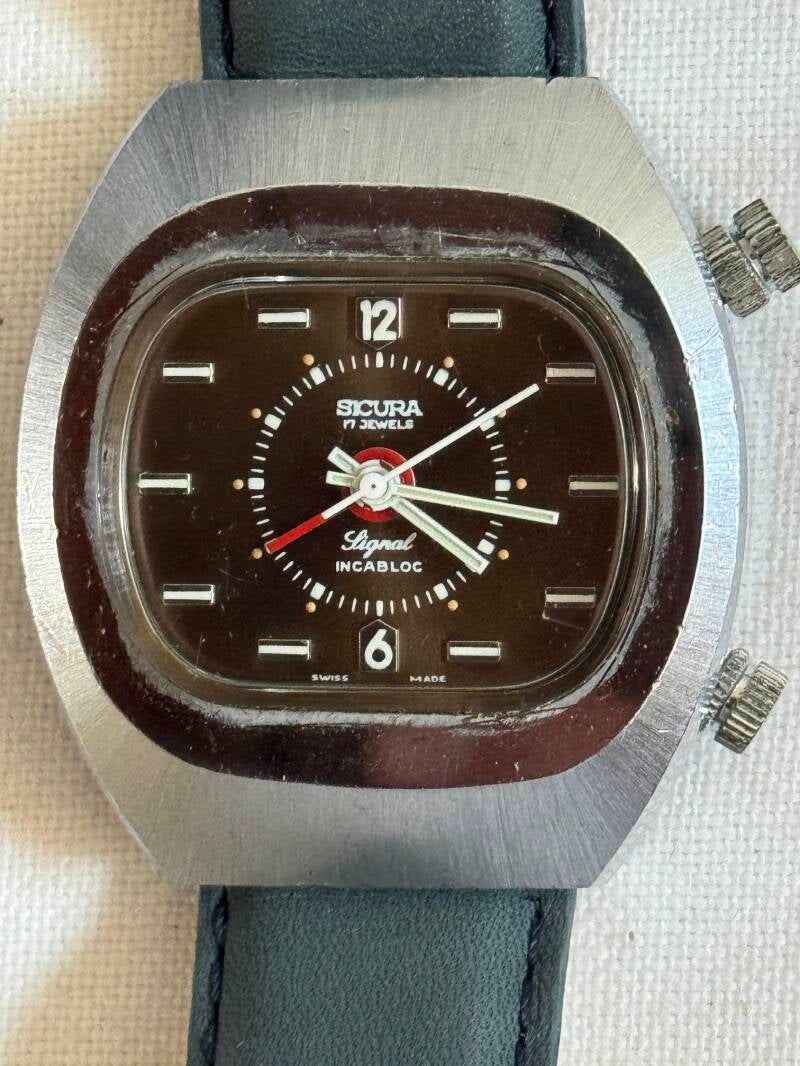
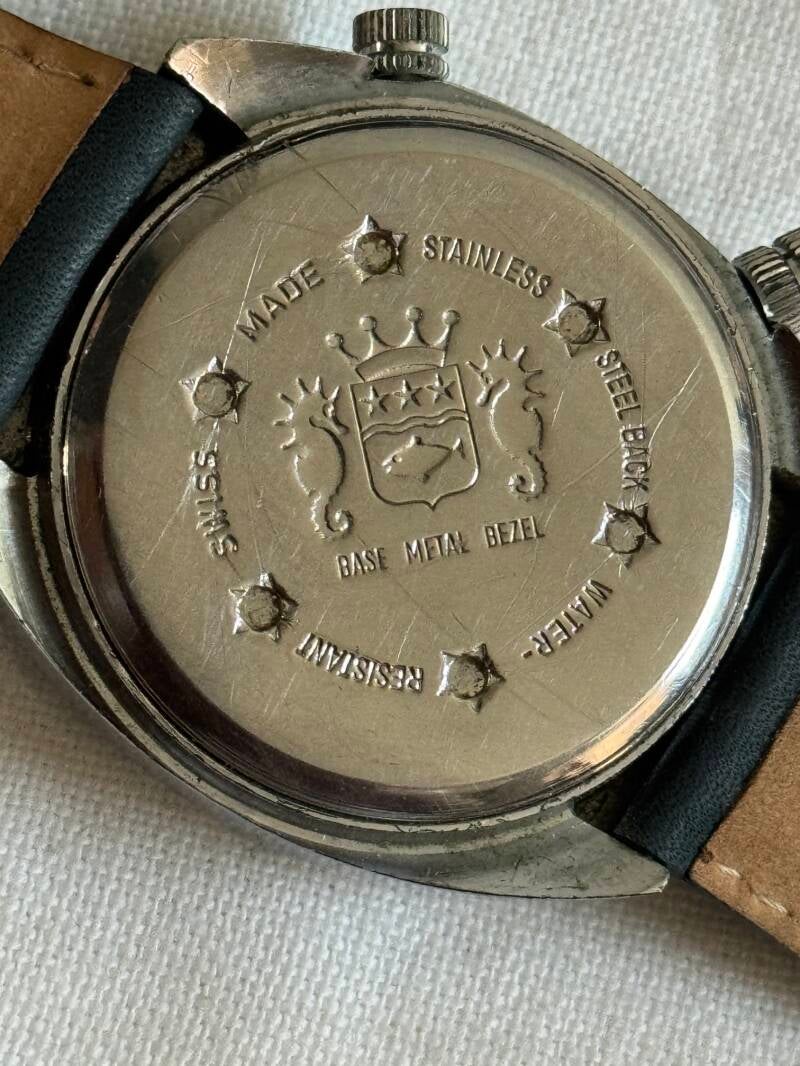
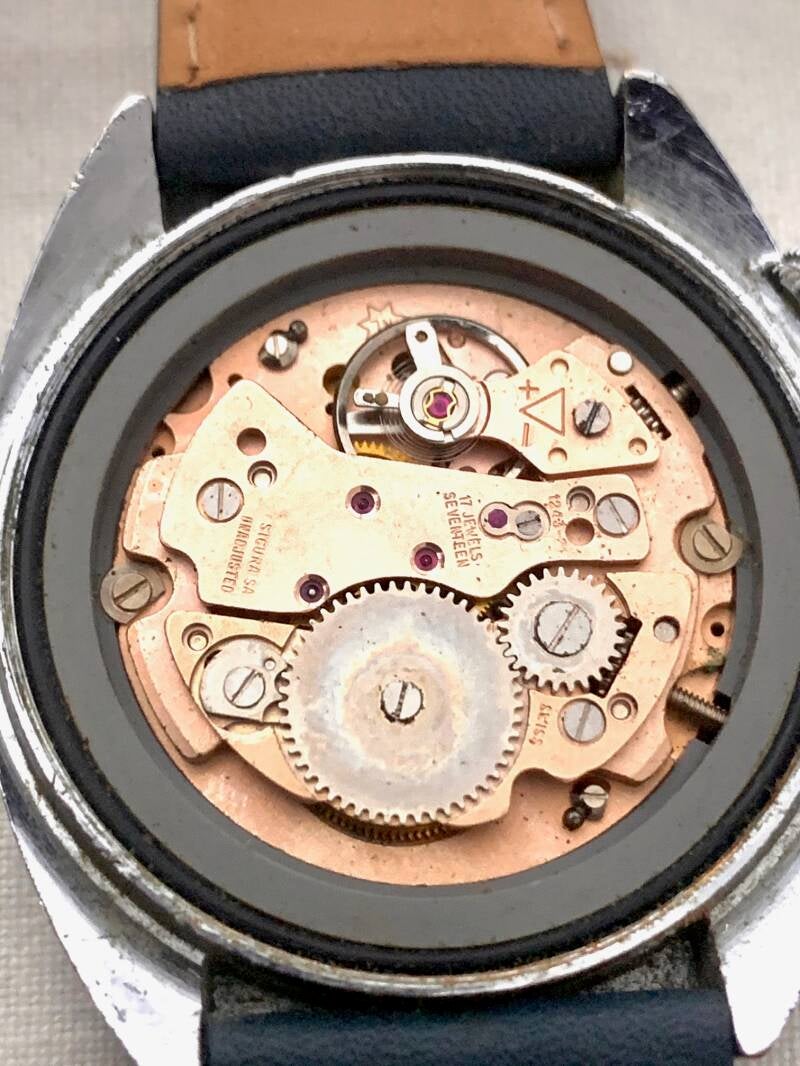
Any serious collector of vintage watches has almost certainly come across Sicura at some point. But I'm not entirely convinced those collectors are actually the ideal audience for a successful heritage-based microbrand revival. And yet that seems to be exactly who Sicura is targeting.


For its first release, the company chose to recreate two of its late-1960s dive watches—the Sicura SuperWaterProof 400 and the Sicura Diver Compressor—combining the inspiration of both into a new model called the Hexa 400. To be honest I'd never heard of either original model before, so I started searching online to see what they actually looked like. One of the best descriptions of the SuperWaterProof, complete with plenty of photos, turned out to be an eBay listing from here. Since that listing may well disappear before you're reading this, I've also included a couple of photos from it so you can get a better idea of what the original watch looked like. So this are not my photos but a copy of the photos shown on the stated ebay listing!
Based on everything I've seen and read so far—including the reviews that have already appeared, although most of them are promotional reviews rather than impressions from actual owners—I decided that Sicura definitely deserved a closer look. I wanted to experience the watch for myself rather than rely on early marketing coverage. So I contacted Mark at SeriousWatches, placed my order, and the watch was on my wrist the very next day.
In my admittedly non-expert opinion, the resemblance between the Hexa 400 and the original is outstanding. You could almost call it a gentle refresh rather than a full reinterpretation. To be fair, though, the original watch was already remarkably modern-looking for its time. Even today, its design doesn't really feel vintage at all. It also offered an impressive level of water resistance back then—one that still commands respect by today's standards.
That said, I won't spend much time comparing every tiny detail between the original and the reissue. I'll leave that to people who actually know the vintage model inside out, rather than someone like me who only became aware of its existence a few days ago and has mostly studied it through photographs. Instead, I'm going to look at the Hexa 400 from the perspective of someone who bought it not because of nostalgia, but simply because I liked the watch itself.
So, let's start from the beginning.
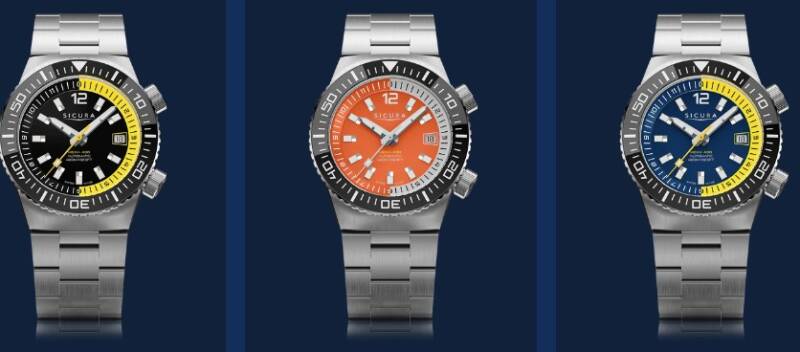
For now, the Hexa 400 is available in three colour combinations. The photos here are taken from Sicura's official website.
Personally, the orange version did absolutely nothing for me. If that had been the only option, I simply wouldn't have bought the watch. It's not that I have anything against it—it's purely a matter of personal taste. That left the blue and black dial versions.
Since both feature a black bezel, a half-yellow inner bezel, a yellow seconds hand, white hour and minute hands, and white hour markers, I felt the black dial created the more balanced overall look. The blue dial, attractive as it is, simply felt like one colour too many for my taste.


So in the end, I ordered the black version.
As mentioned, the people at SeriousWatches did a great job, and the package with the watch was already in my hands the very next day. The first impression was a good one. The box, or rather the original packaging, showed that Sicura once again wanted to do something a little different. The packaging is not just another generic box. A nice touch.
After removing all the protective films and starting to resize the bracelet, I encountered my first disappointment.
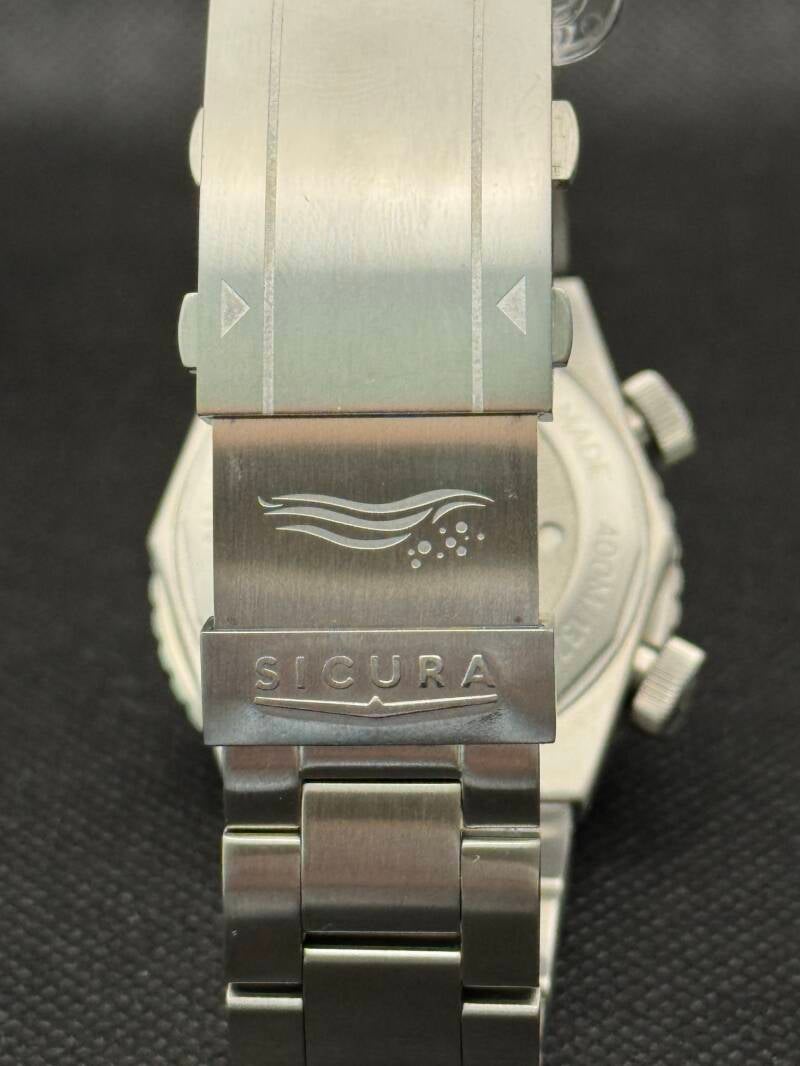
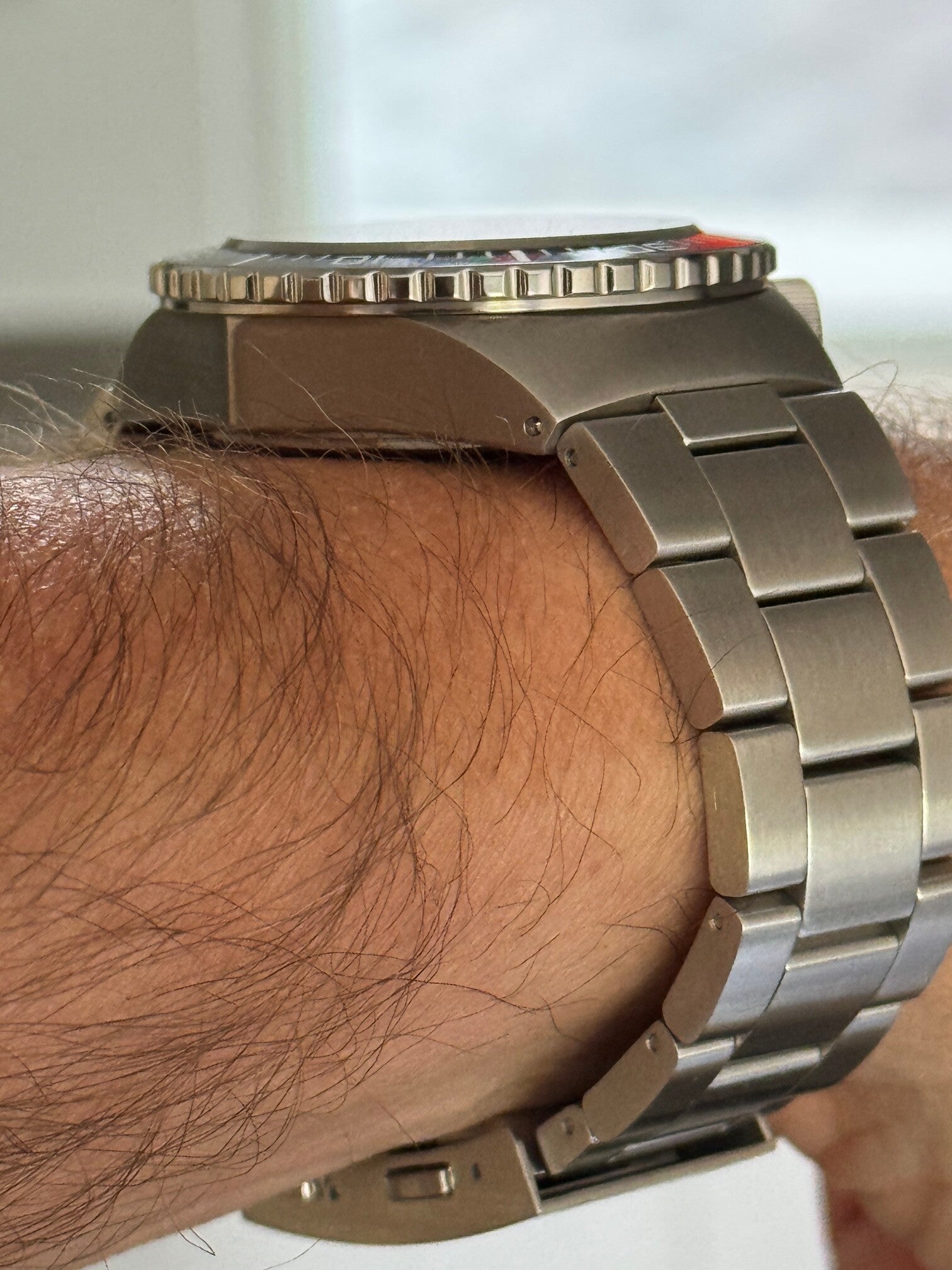
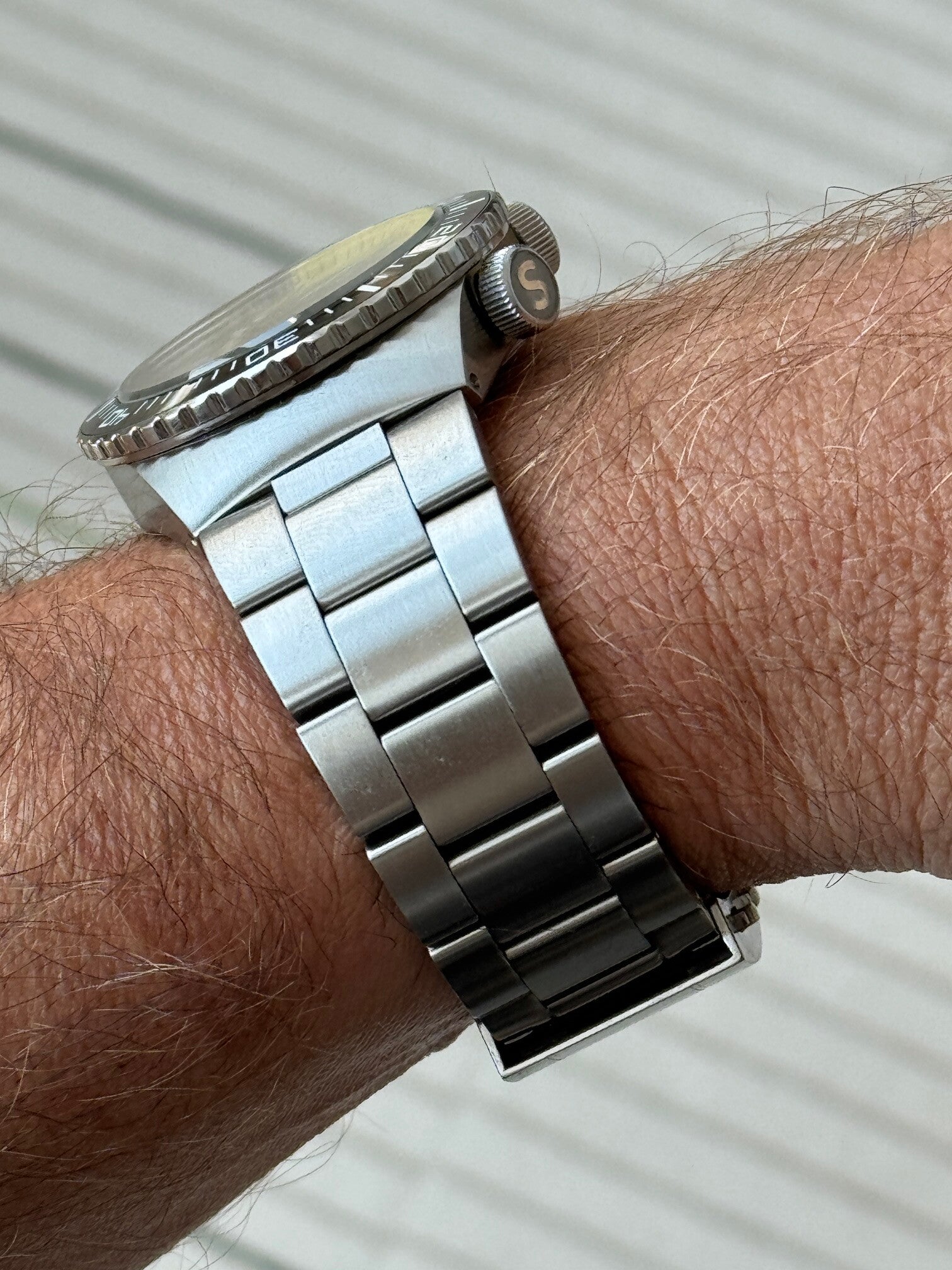
The bracelet is made of three-link sections (aka Oyster-style), and the links are quite large (10 mm). They are connected with simple screws. At first glance, everything looks perfectly fine. The problem, however, is that the bracelet does not have any half-links. With 1 cm links, it is difficult to adjust the bracelet perfectly to every wrist size.
In my case, with my wrist just under 19 cm, removing one link left the bracelet noticeably too loose, while removing two links made it slightly too tight.
Of course, the counterargument to this problem is that the bracelet features a large diver extension clasp, which allows very precise length adjustment without even having to take the watch off your wrist. However, this is a "true" extension, not the type of extension where at least one additional link is hidden inside the clasp. As a result, when the extension is deployed, the bracelet does not look particularly good on the wrist. And if you already need to activate the extension just to achieve the basic wearing position, then for me that is not an ideal solution. This type of extension makes sense only for occasional expansion, for example over a wetsuit.
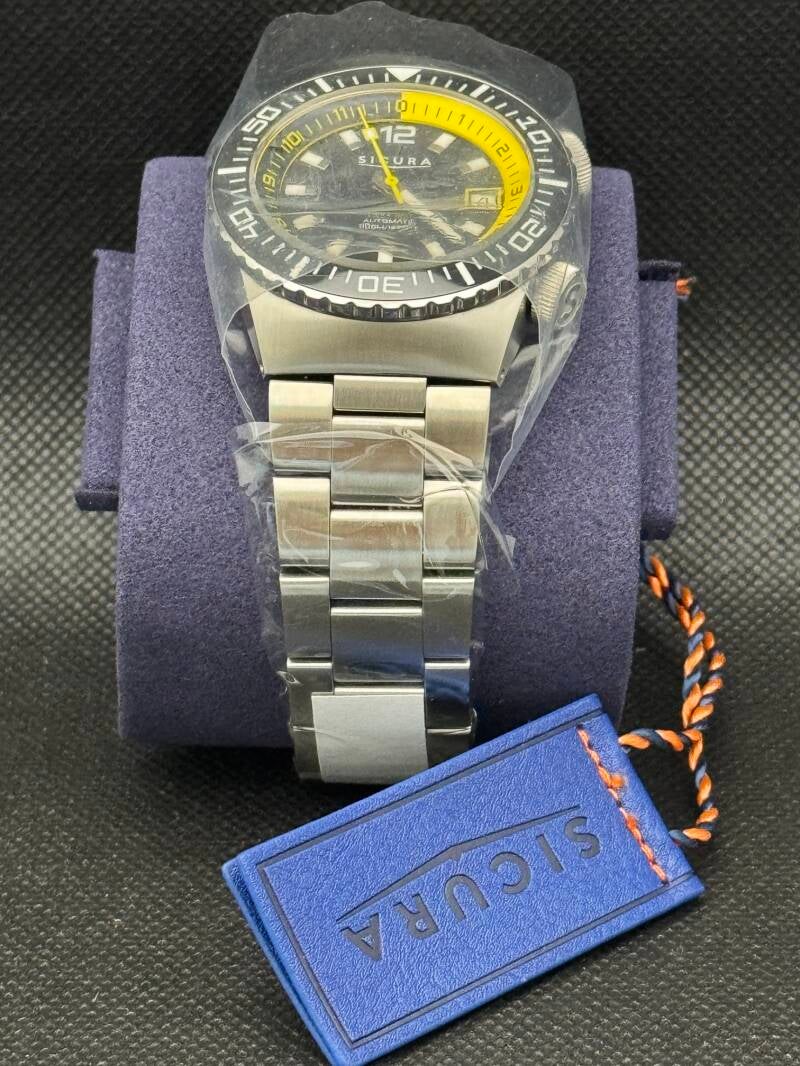
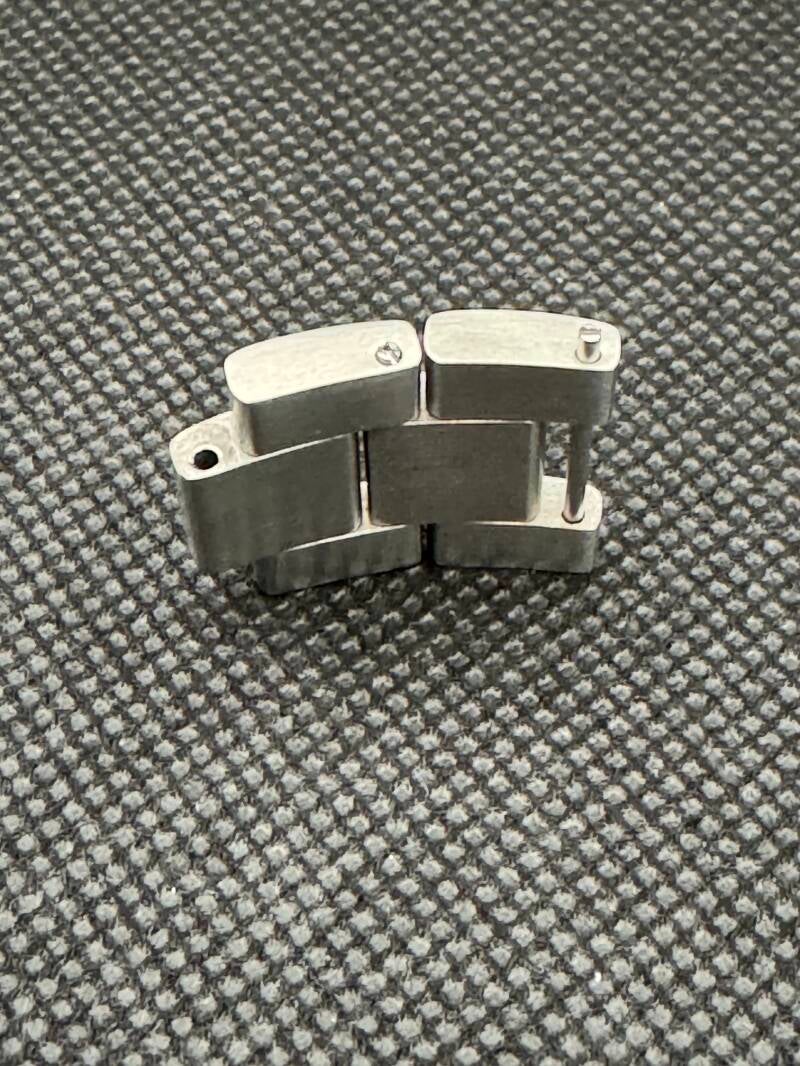
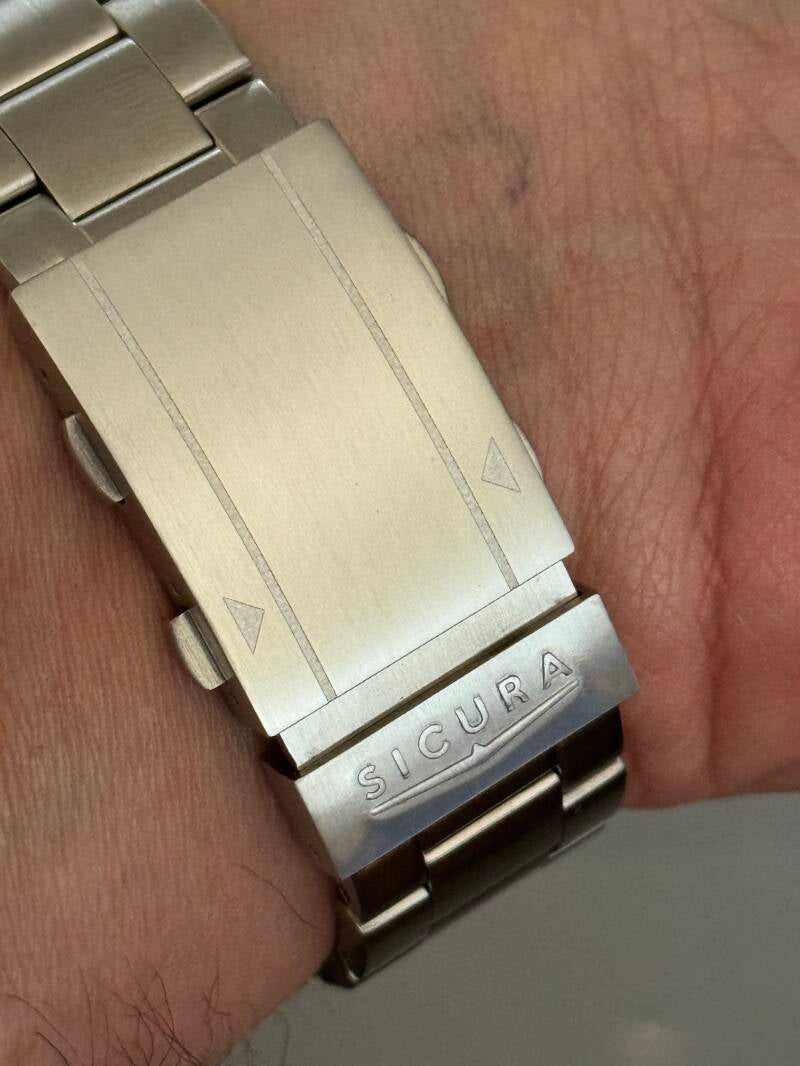
The second thing a user immediately notices is that the watch, together with the bracelet, is quite heavy. Specifically, after removing two links, the total weight is 185 grams. Fortunately, I have to immediately point out that the weight is very well balanced between the watch head and the bracelet. As a result, despite its mass, the watch is surprisingly comfortable to wear and sits very nicely on the wrist.
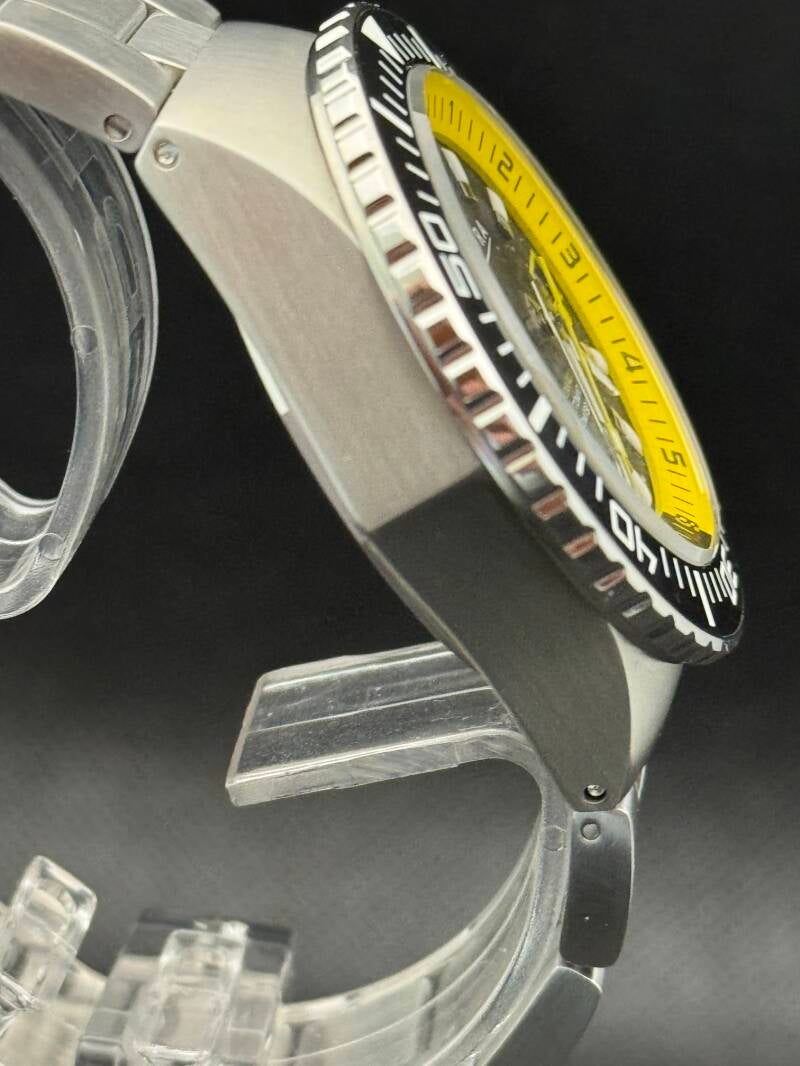
The overall shape and architecture of the watch are quite unusual. Its defining feature—and the reason behind the name—is the hexagonal case, a design element that, as far as I can tell from photos, was already present on the original model.
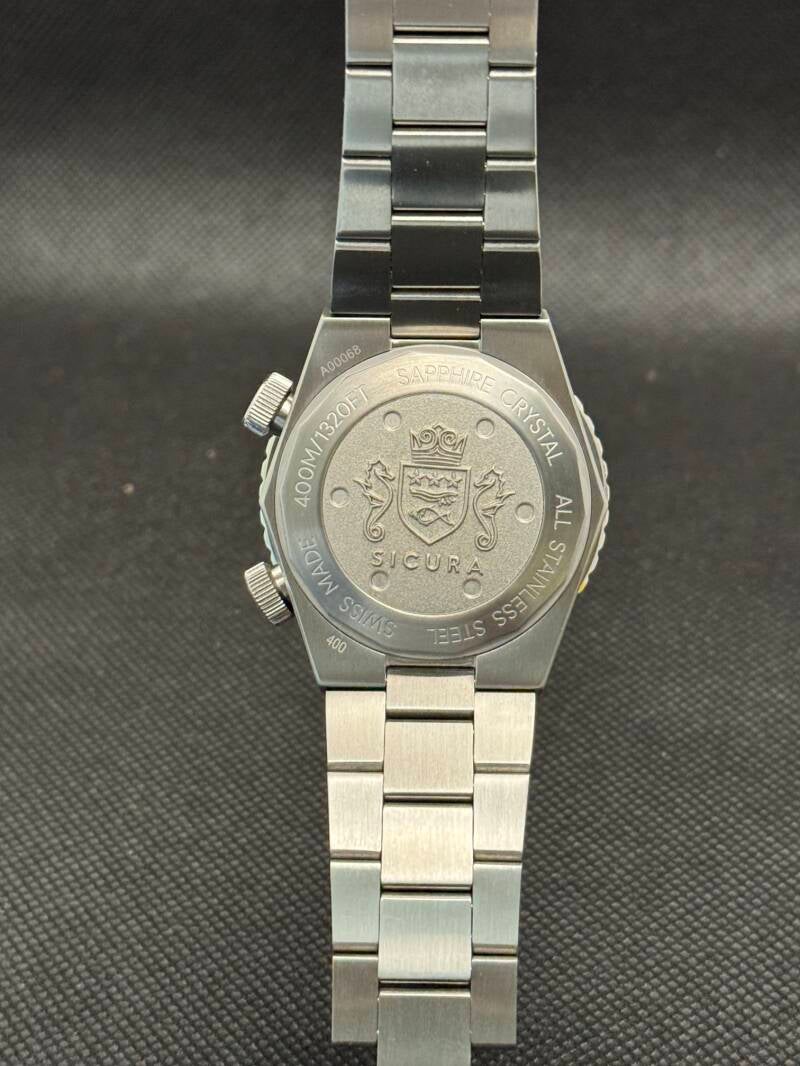
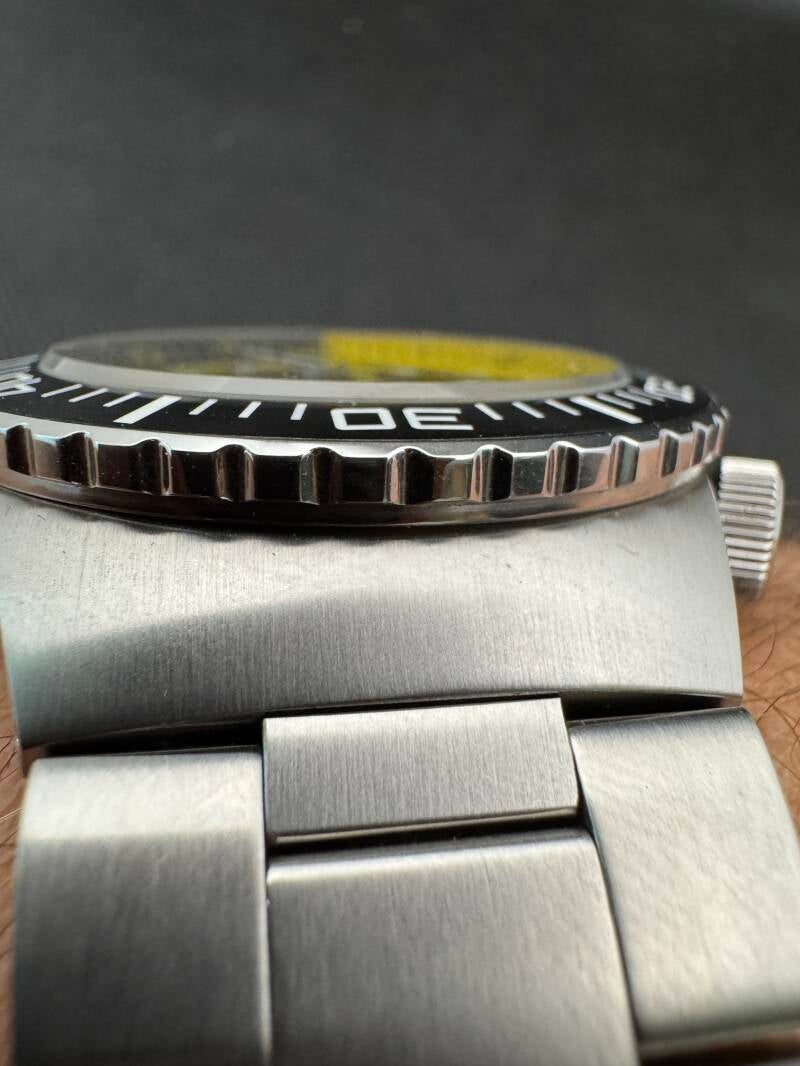
The case itself is actually quite narrow. Measuring just 39 mm across its widest points across the tips of the hexagon, the hexagonal shape—with the sides cut away from what would otherwise be a round case—makes it appear even slimmer. The case flows into 24 mm lugs—remarkably wide for a case measuring just 39 mm across—with the bracelet fully integrated into the design. From there, the bracelet tapers down to 20 mm, while the clasp measures 22 mm across.
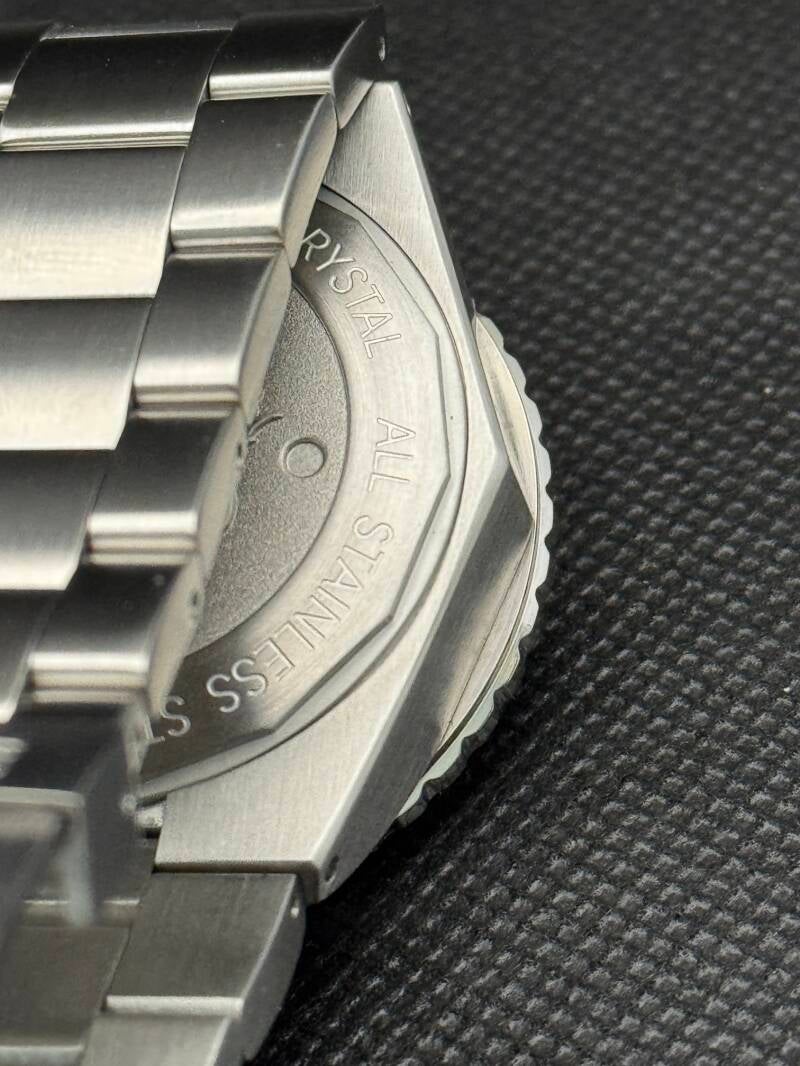
And this is where the watch becomes somewhat contradictory.
The ratio between the width of the case and the width of the bracelet is unusually small. On the one hand, this creates a very interesting effect. If it weren't for the two crowns protruding from the case, the whole watch would almost look like a bracelet with a slightly oversized decorative element in the middle. It gives the watch a distinctive and rather unconventional appearance.
On the other hand, this same concept means that the bracelet becomes the dominant visual element. It completely overshadows the watch head itself. The substantial bracelet also adds quite a bit of weight, making the watch heavier than it probably needed to be. The overall impression is that of a very substantial—perhaps even overly substantial—tool watch. It's certainly too chunky for anything other than casual wear or serious diving.
One more thing I'd like to point out is that I feel the bezel somehow undermines the uniqueness of the hexagonal concept. The hexagonal design simply isn't fully exploited. Viewed from above, you barely notice the hexagonal shape at all, which I think is a missed opportunity. I'm not entirely sure how this could have been addressed. Perhaps a non-circular bezel would have helped. Just a thought... Interestingly, when viewed from the back, the watch once again emphasizes the slimness of the case, because the bezel no longer dominates the silhouette. That said, at 41 mm in diameter, the bezel does at least help visually balance the exceptionally wide bracelet.
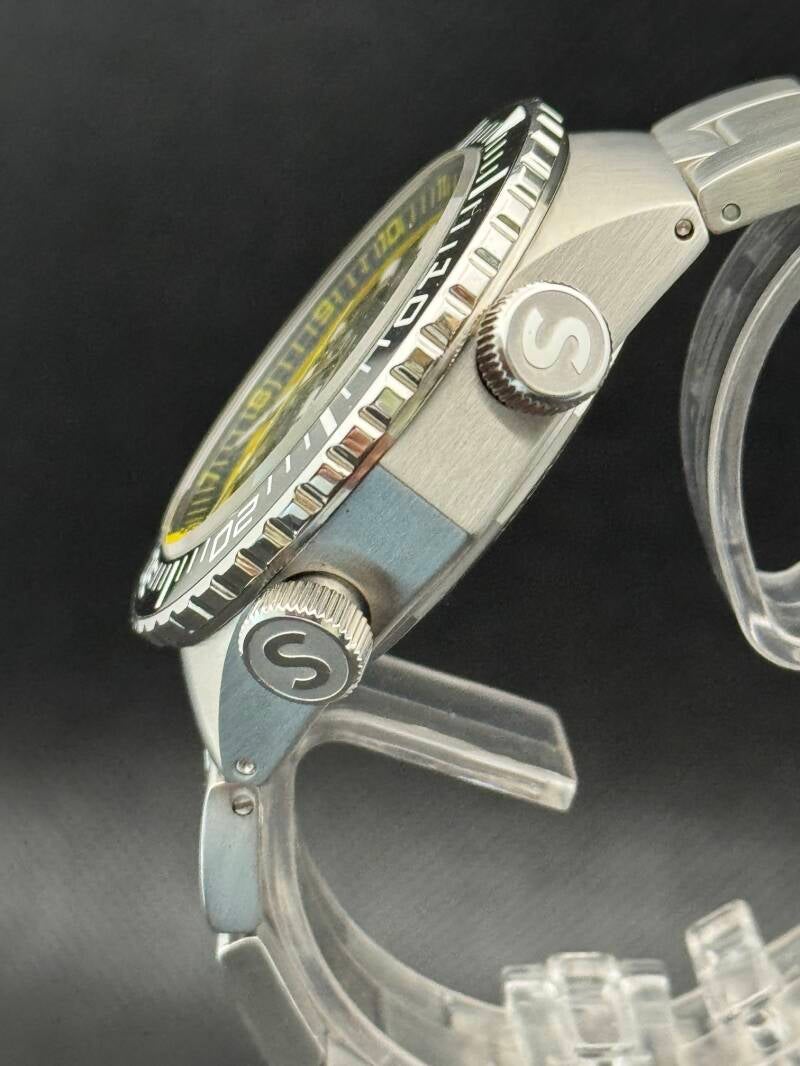
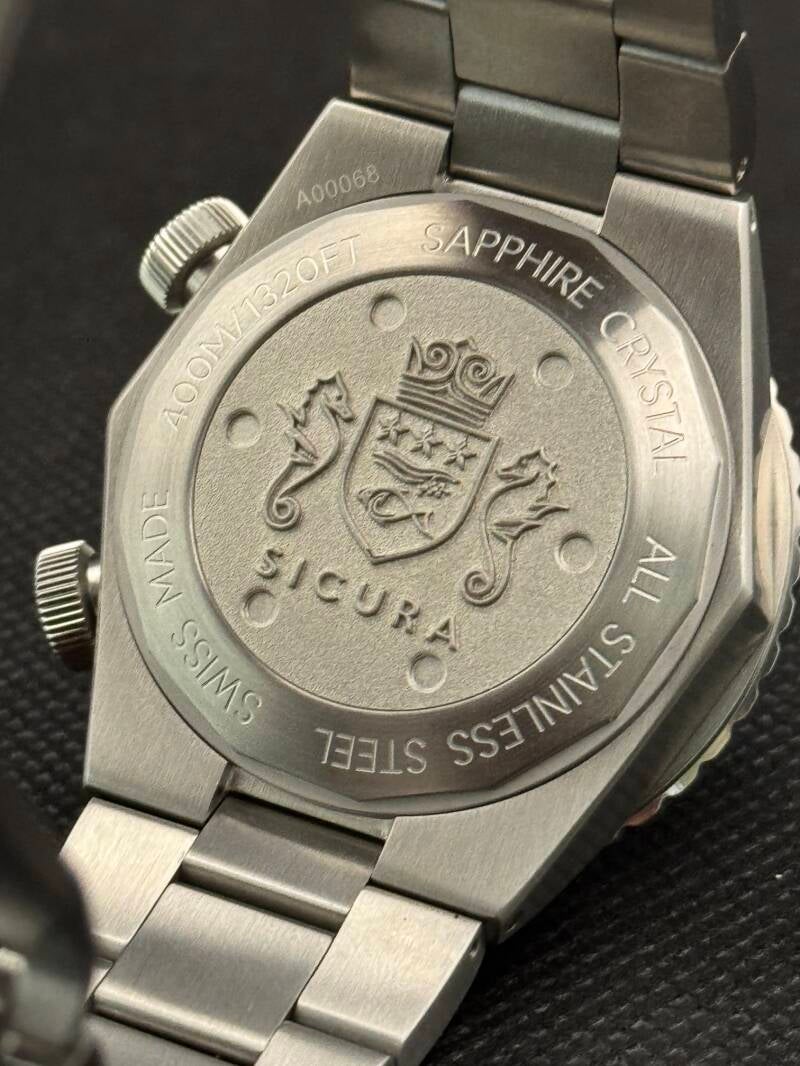
Both crowns are screw-down crowns, which is exactly what you would expect from a watch with 400 m water resistance. Unlike the original model, the upper crown now controls the rotation of the internal bezel, while the lower crown operates the timekeeping mechanism.
Somewhere I read that precisely setting the internal bezel can be slightly problematic because it can be difficult to screw the crown back down without accidentally moving the bezel as well. I have to admit that I personally have absolutely no issues with this. I unscrew the crown, set the bezel, screw it back in, and the bezel does not move during the screwing-back process.
The original Sicura logo is engraved on the case back. This was actually one of those small moments that made me smile, as I compared the back of my alarm watch with the back of the Hexa.
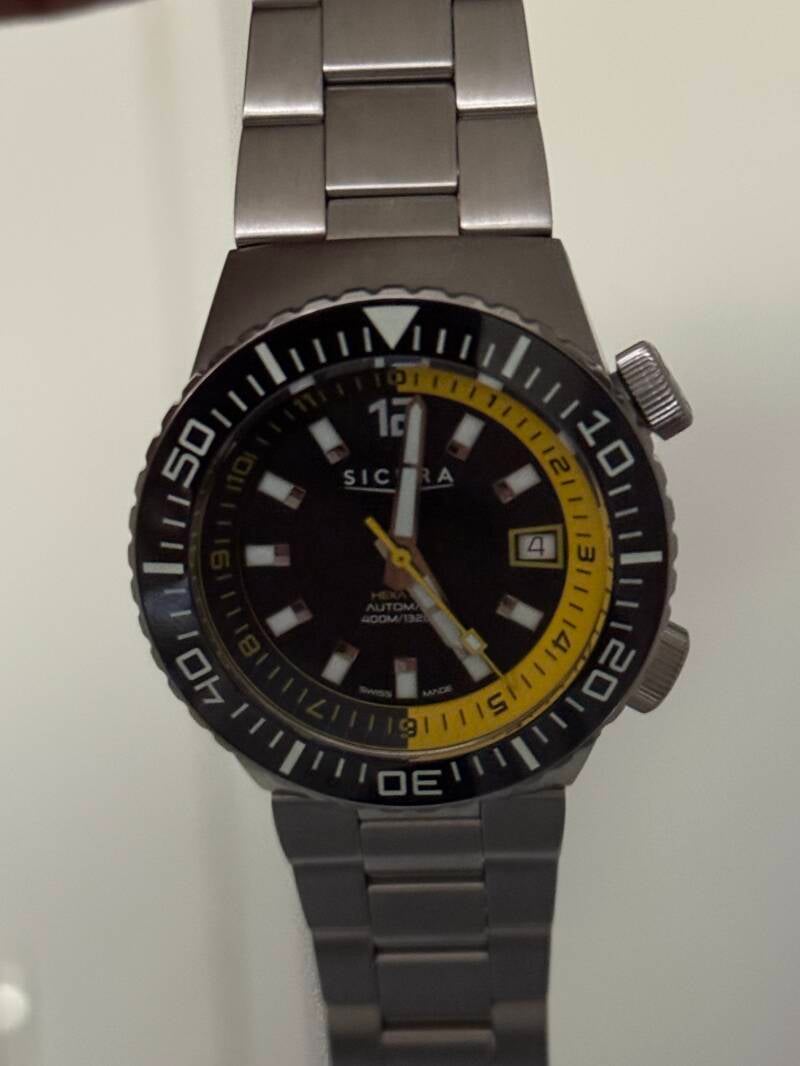
Let's take a closer look at the dial, which gets its distinctive character from the inner bezel.
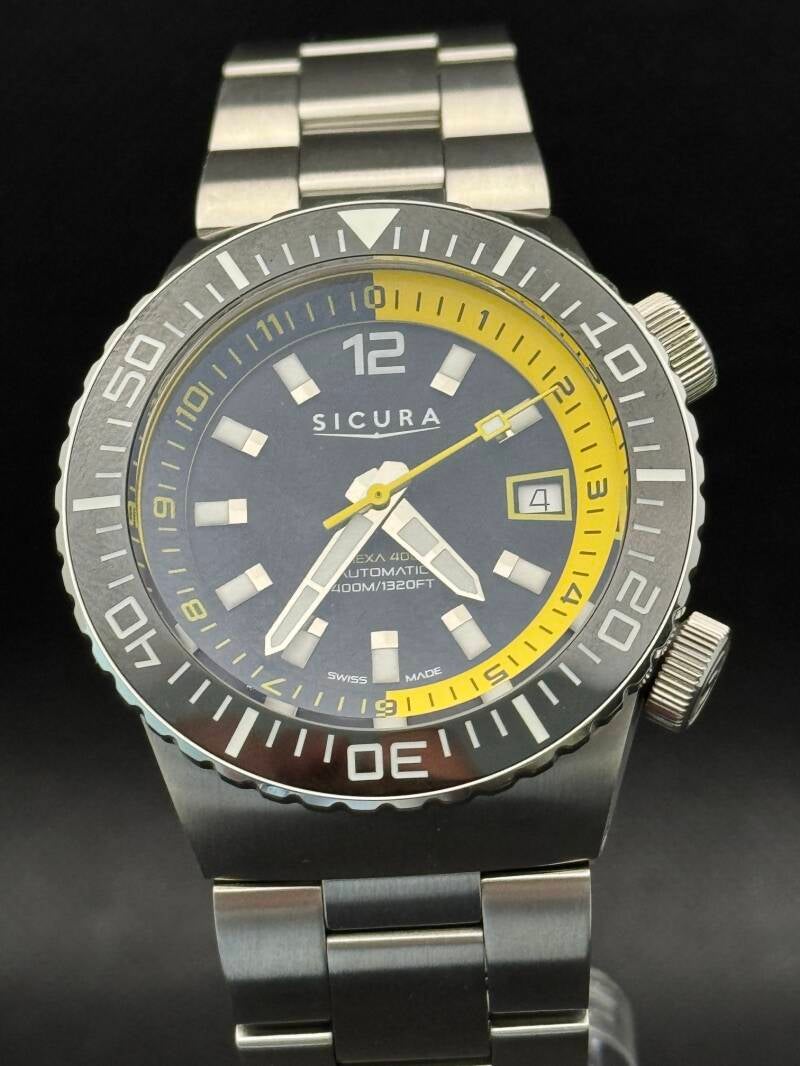
The first thing I noticed was the slightly unusual hour numbering on the inner bezel. Instead of 12, the bezel uses 0. If we consider the inner bezel as a "continuation" of the outer bezel, allowing the two to work together to set the start of a dive that can last longer than one hour (which is, after all, the basic purpose of a dive watch), then this numbering actually makes perfect sense. On the other hand, the inner bezel can also be used as a simple tool for tracking a second time zone, meaning that in a way it provides a GMT-like function. For this purpose, however, using 0 instead of 12 is rather unusual. As far as I know, the only brand that regularly uses 0 instead of 12 across its watches is Raketa. Interestingly, in the original model the inner bezel was numbered from 13 to 23, while the starting position itself had no number. That implicate that internal bezel's purpose was closer to being "fake" GMT.
To be honest, I don't really know why half of the inner bezel is yellow and the other half black. Different colours on either an inner or outer bezel are usually found on 24-hour GMT watches, where the darker section represents night hours (18:00–06:00) and the lighter section represents daytime. Here, however, I can't find any obvious logic behind why 0–6 is the lighter section and 6–0 the darker one. Other than the possibility that it simply serves as a way to add some colour and character to the dial.
That said, the way Sicura combined the yellow and black elements is actually very well executed. Black numerals on the yellow section, yellow numerals on the black section, a yellow frame around the date window, a yellow seconds hand, and a subtle yellow Hexa 400 inscription on the black dial. Combined with the black ceramic outer bezel, the whole design feels very cohesive.
Personally, I could live without the "automatic" and "400m/1320Ft" inscriptions. Dail would be cleaner.
When it comes to the hands, Sicura followed the original design very closely. Personally, I find them slightly too wide. On the positive side, this leaves plenty of space for Super-LumiNova, which performs very well. Not only does it glow strongly at the beginning, but it also remains visible for a very long time.
One small detail is also important here—something that cannot be taken for granted with this type of revival of former Swiss brands. The dial carries the "Swiss Made" marking. Namely, it is not uncommon for once-successful brands to be revived under new ownership with production moved somewhere to Asia. I don't want to generally imply that watches produced under a revived brand name are of poor quality, but the true "heritage" aspect is certainly lost in the process.

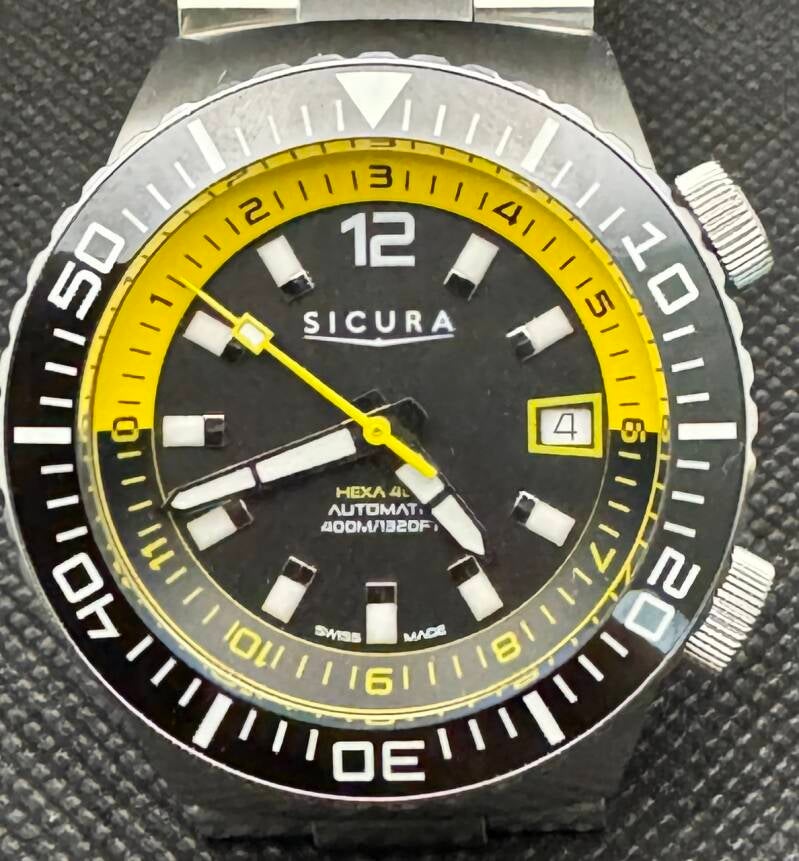

The external bezel rotates unidirectionally with 120 clicks. The action is rather firm, which I actually like. There is absolutely no chance of accidentally moving it, which is definitely a plus for a dive watch. The sapphire crystal sits slightly proud of the bezel. The transition between the bezel and the crystal is not completely seamless.
Consistent with the Swiss Made marking, the watch is powered by a Sellita SW200-1 movement, which doesn't really need much introduction. I can only say that it is nicely regulated. With normal daily wear, the watch runs approximately -2 seconds per day.
As usual, I owe you a few wrist shots as well. They clearly show that the watch sits very well on a wrist of my size, although the bracelet is definitely quite a statement piece. Mainly because of its width, I feel that the watch probably wouldn't look as balanced on wrists smaller than 18 cm.
I haven't mentioned yet that the watch has a relatively short lug-to-lug measurement—just 46 mm—which contributes significantly to the way it wraps nicely around the wrist. It is, however, quite thick at 14 mm, although that is once again something you would expect from a watch rated for 400 m of water resistance.
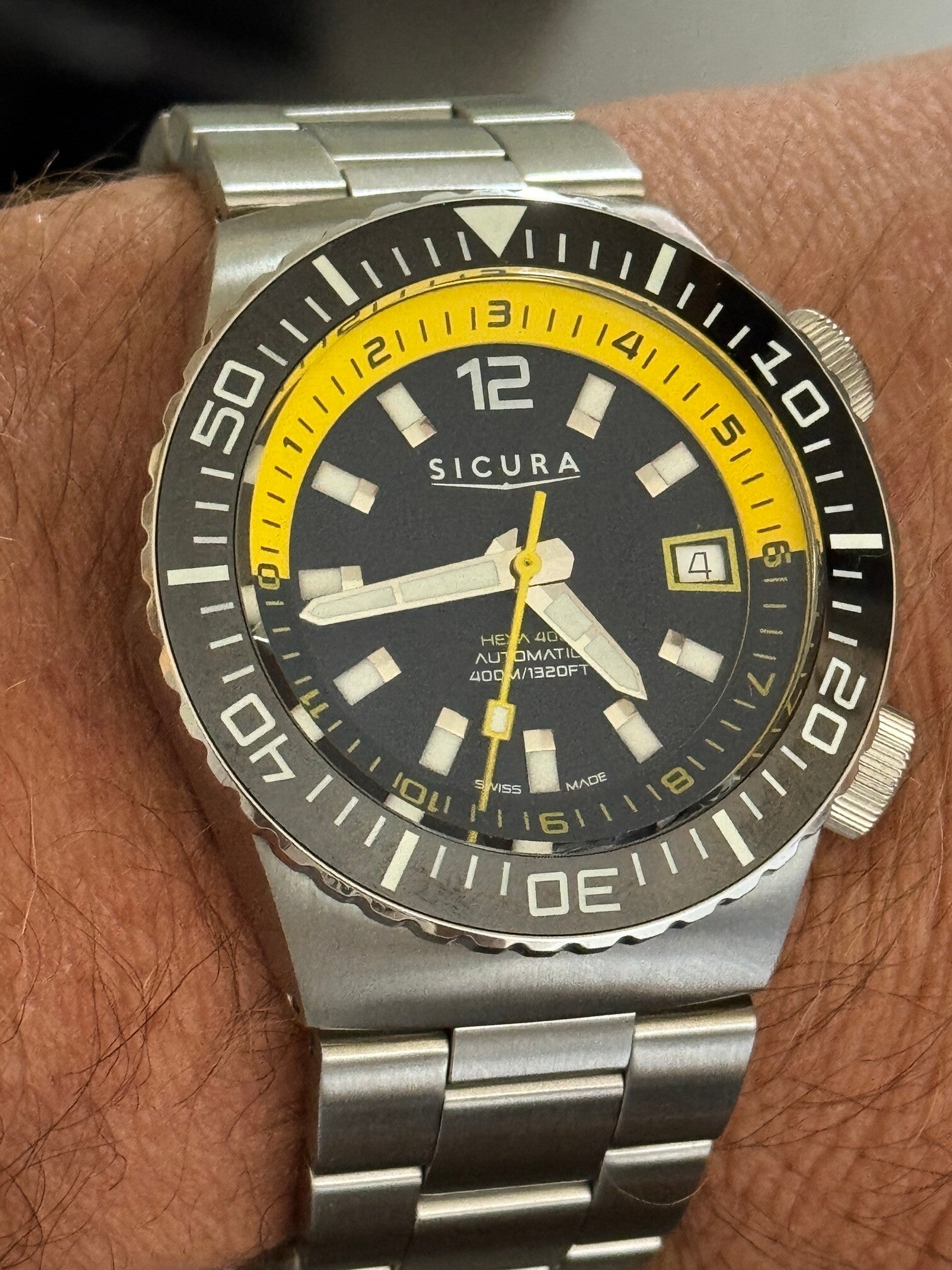
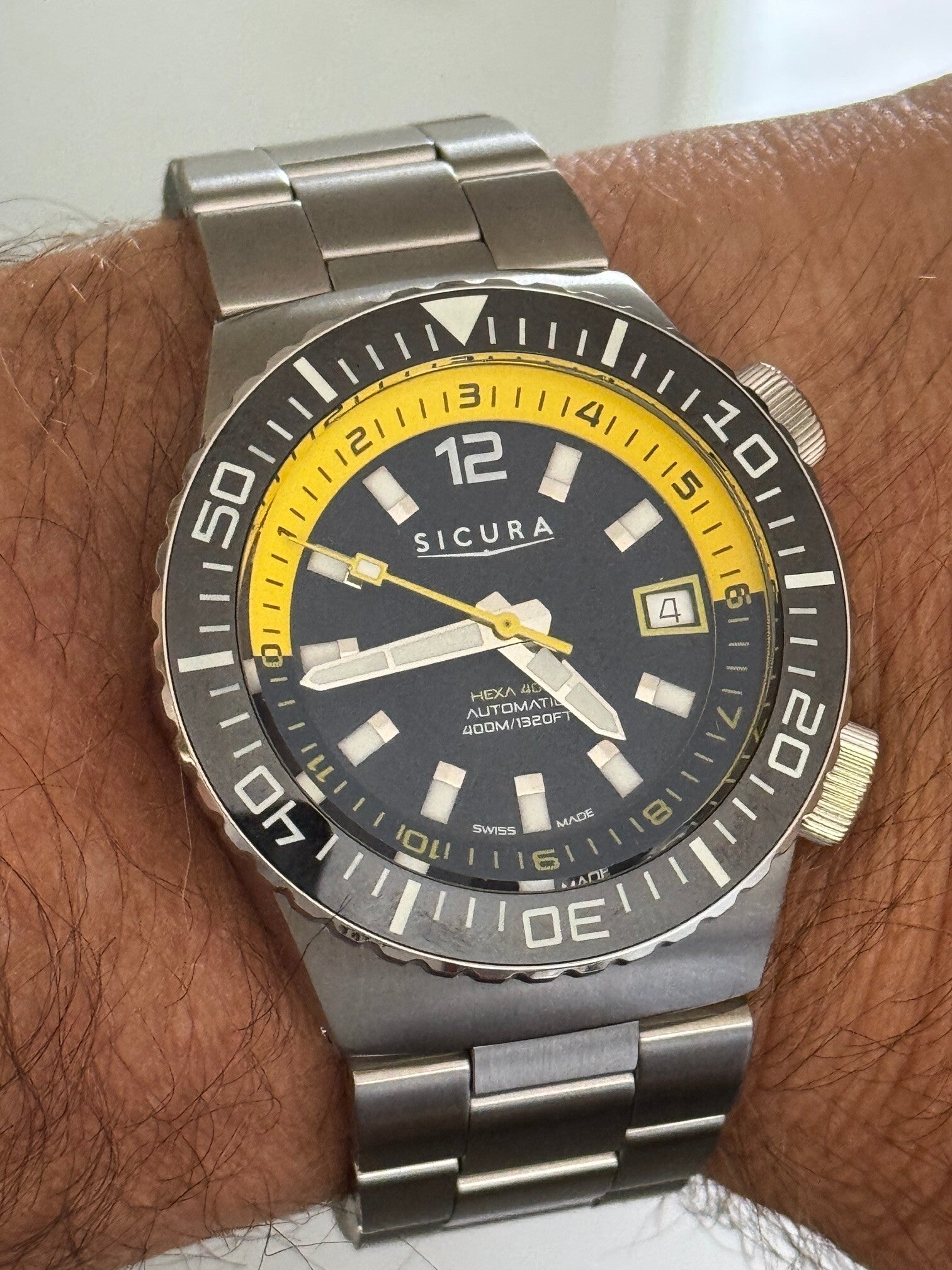
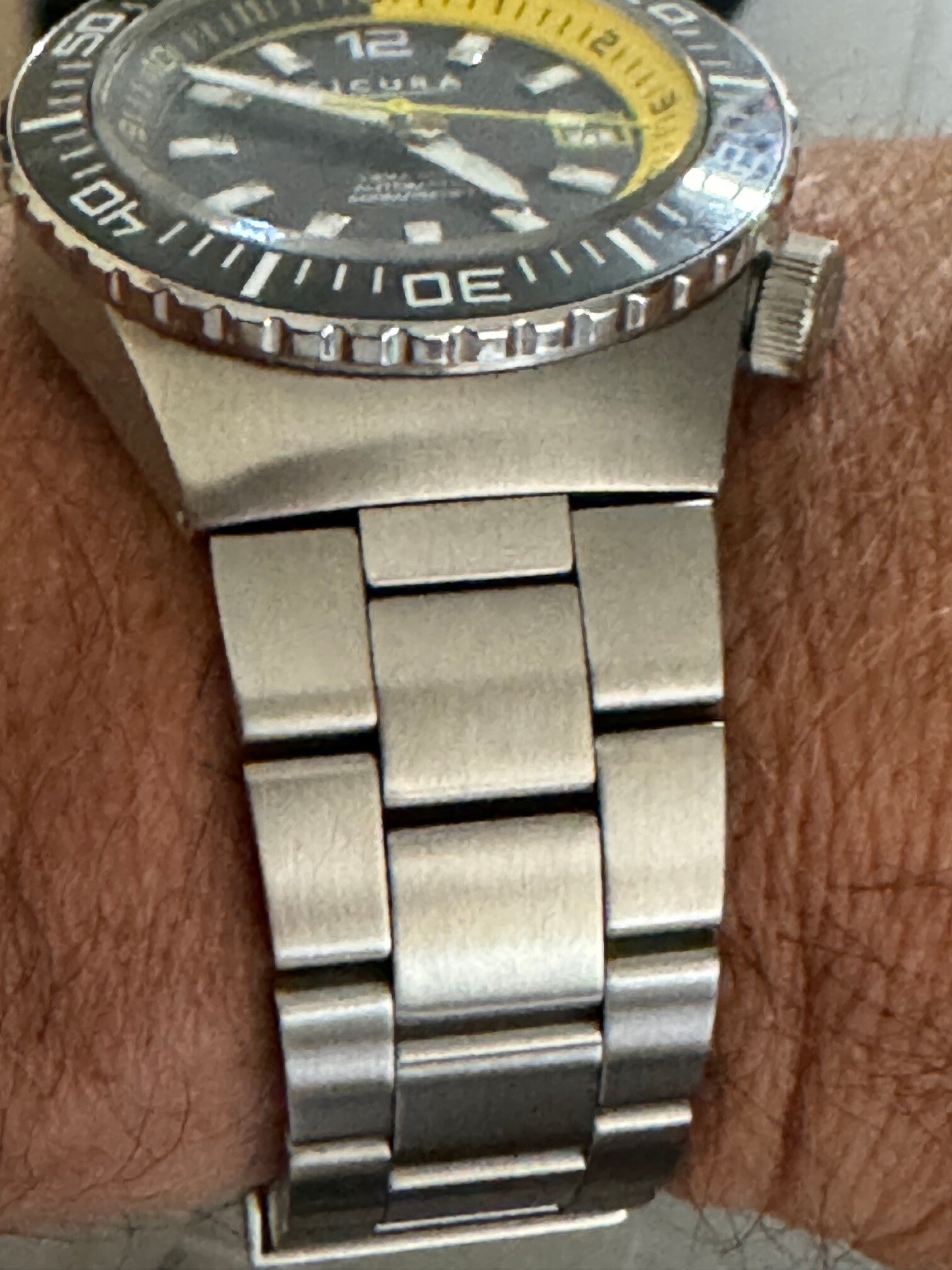
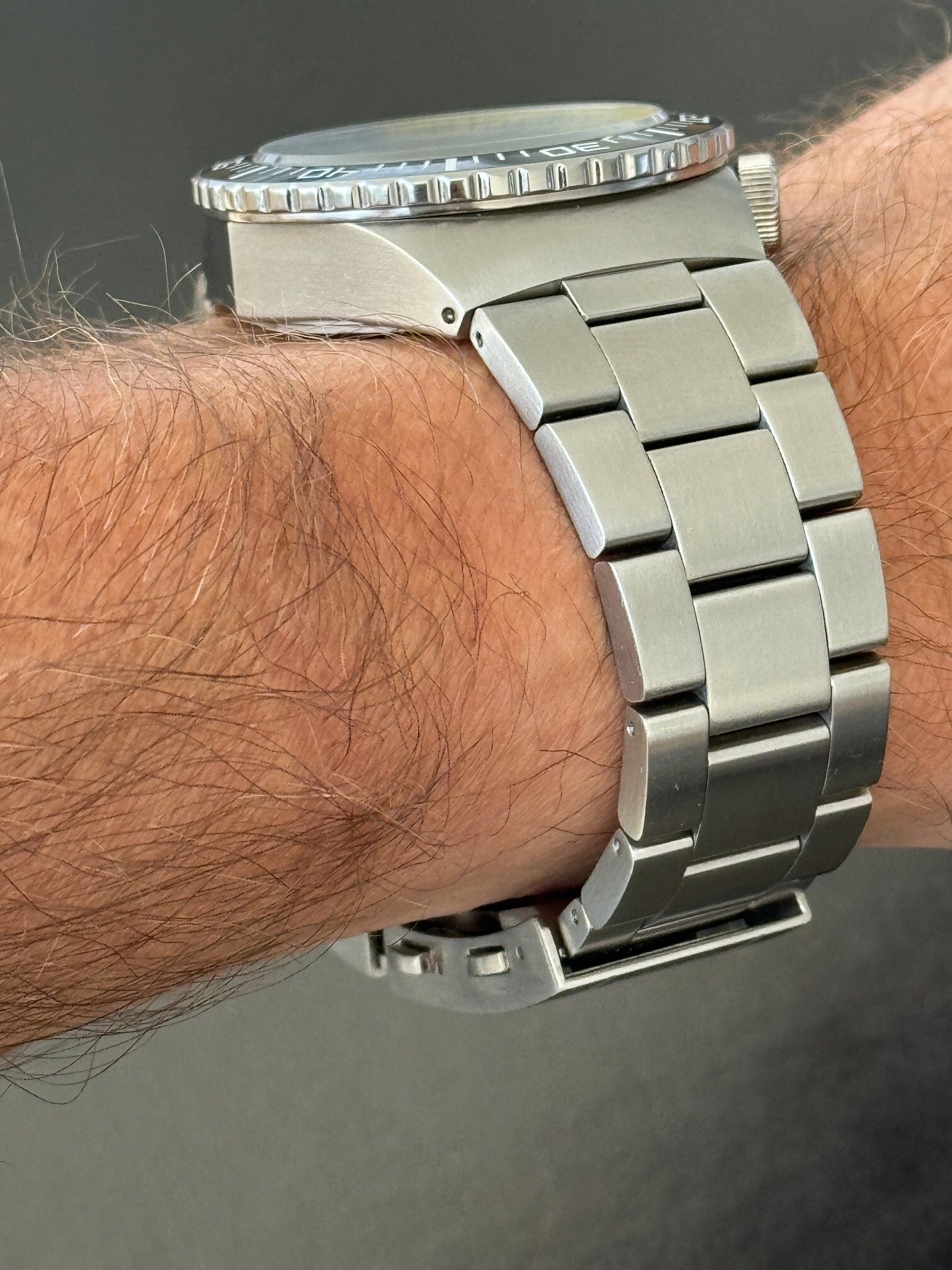
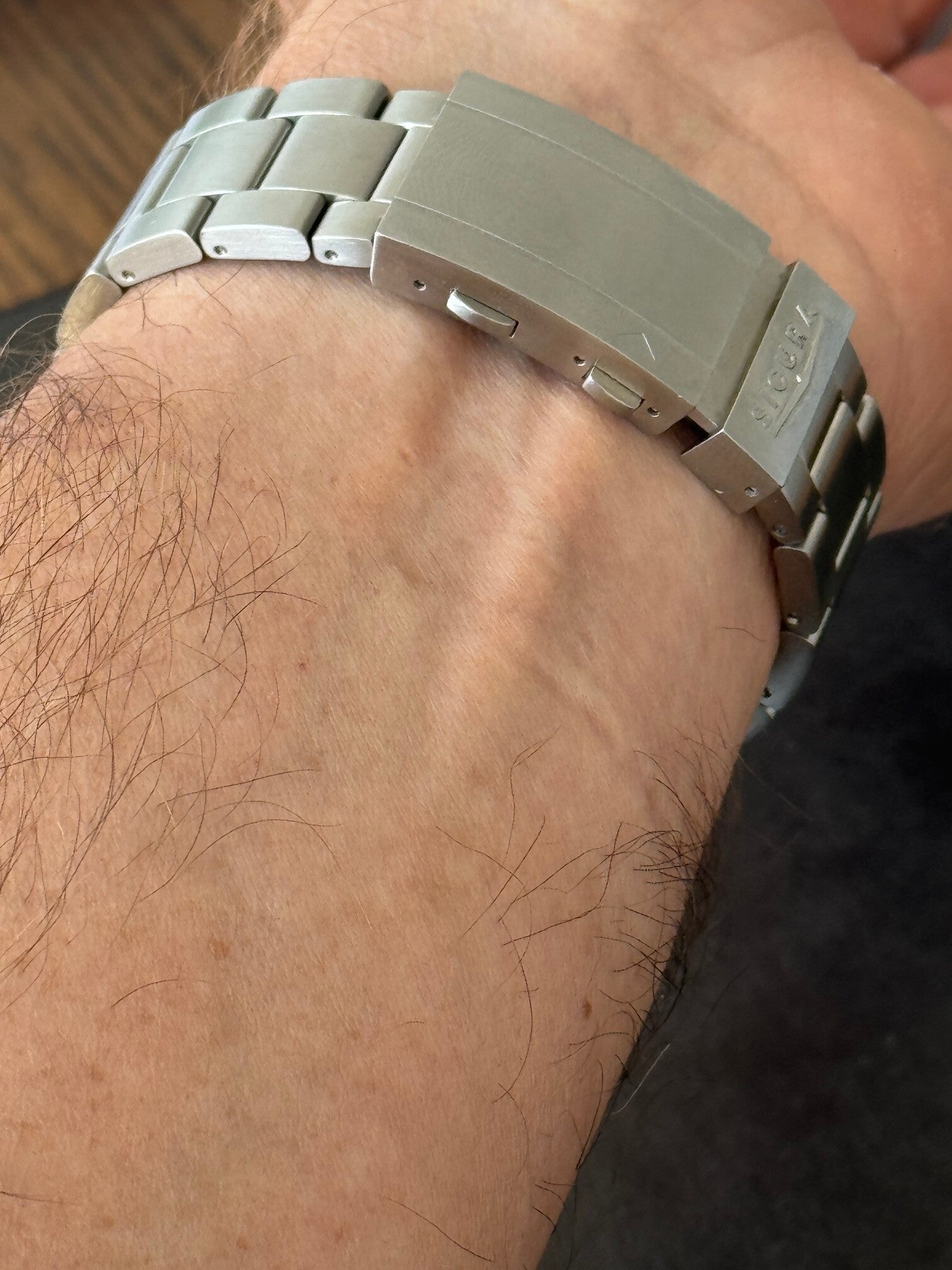
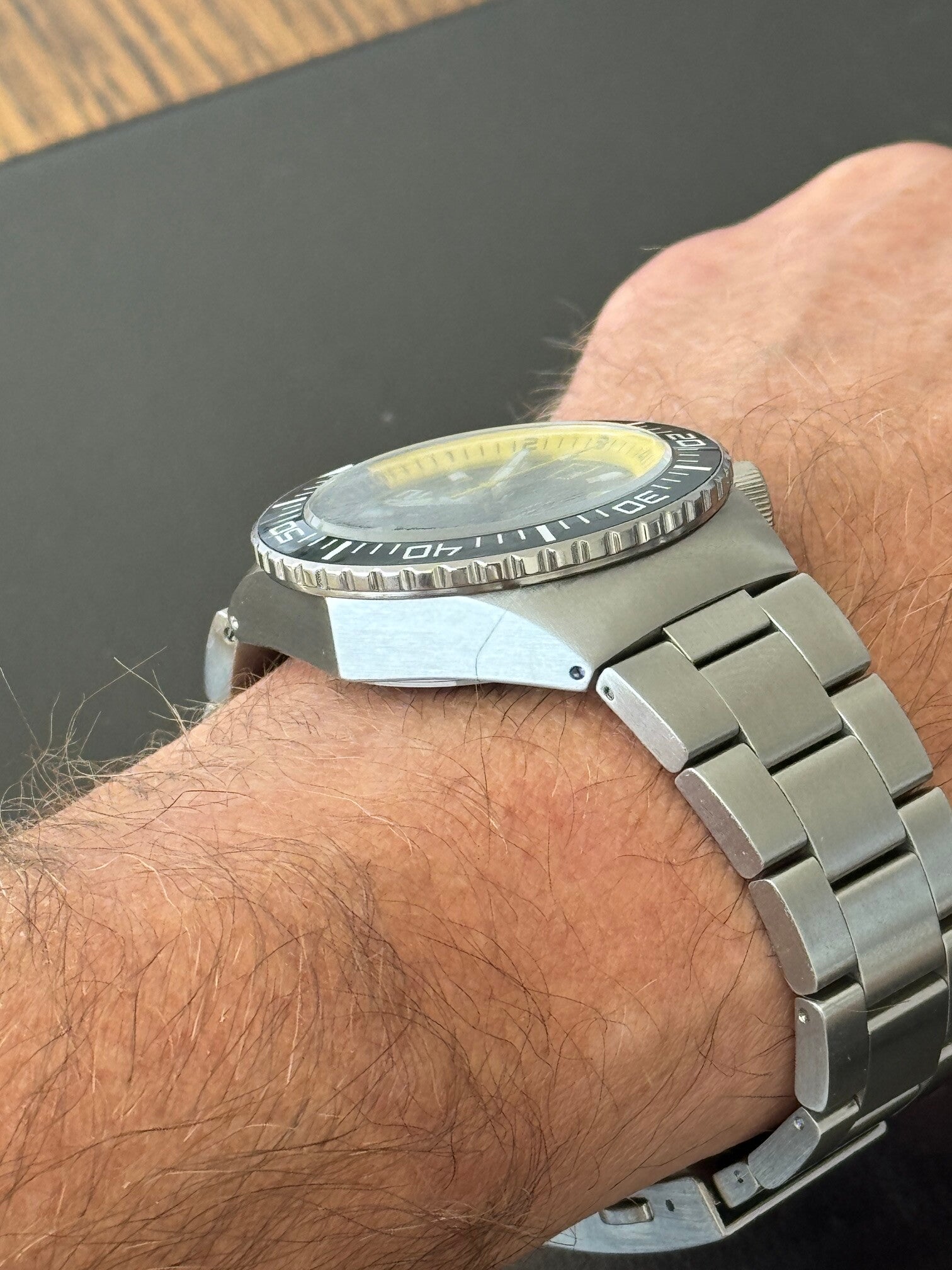
The watch is priced at €1,450 in the EU. I would call this a fair price considering the quality, what the watch offers, and the price levels that have become established in today's microbrand world. However, in my opinion, it is probably a little too high for a brand trying to make a quick breakthrough and create hype among watch enthusiasts.
That being said, I can definitely say that for this price, the buyer gets a very good—and above all, very interesting—product. It is different from most other dive watches on the market, although this uniqueness probably also means that Sicura is consciously giving up a certain segment of potential buyers. This is probably not a watch for someone looking for the most technically accomplished dive watch in this price range. There are plenty of excellent alternatives available today. The Hexa 400 is aimed at someone who values character, originality, and a design that does not simply follow established trends.
I find it very commendable that Sicura is not simply trading on its historical name, but is trying to capture the character that made the original brand distinctive. Because of that, I will be following the future development of Sicura with great interest. Saying that, I sincerely hope they keep this "something different" approach, but that it will not be based solely on reviving some of the most iconic watches from Sicura's golden era. The original brand was interesting not only because of individual models, but because of its unconventional approach and willingness to do things differently. That is the spirit I hope the new Sicura will preserve.
And, at the end, I have to thank Mark and his entire team in Serouswatches.com for another great purchase experience.
Add comment
Comments